Sydney Reibschied

Yale University and Yale-NUS College
Yale Homelessness and Hunger Action Project Big Sib Tutor

Biography

I majored in Life Sciences and will be going to medical school next year! I am passionate for biology and also find joy in teaching this passion to others through tutoring. I have the ability to break down complex biology and explain it in more simple, easier to understand methods which helped me to score high on my MCAT I took this year. I would love this position and think the flexible schedule is perfect for me.

Education

BS Life Sciences
Yale University and Yale-NUS College

Educator Statistics

Numerade tutor for 5 years
236 Students Helped

Topics Covered

Discover the Power of the Cell: Unleash Your Potential with Our Products
Unlocking the Secrets of Cell Signaling: Understanding the Intricacies
Defending Against Viruses: Tips and Strategies | Your Ultimate Guide
Exploring Animal Reproduction and Development: A Comprehensive Guide
Population Ecology: Understanding the Dynamics of Living Systems
Mastering Metabolism 101: A Beginner's Guide
Exploring Population Evolution: Trends and Insights
Carbohydrates, proteins, and lipids
Carbohydrates and Nucleic Acids: The Building Blocks of Life
Boost Your Immune System: Tips and Tricks for a Stronger Defense

Sydney's Textbook Answer Videos

04:26
Fundamentals of Biochemistry

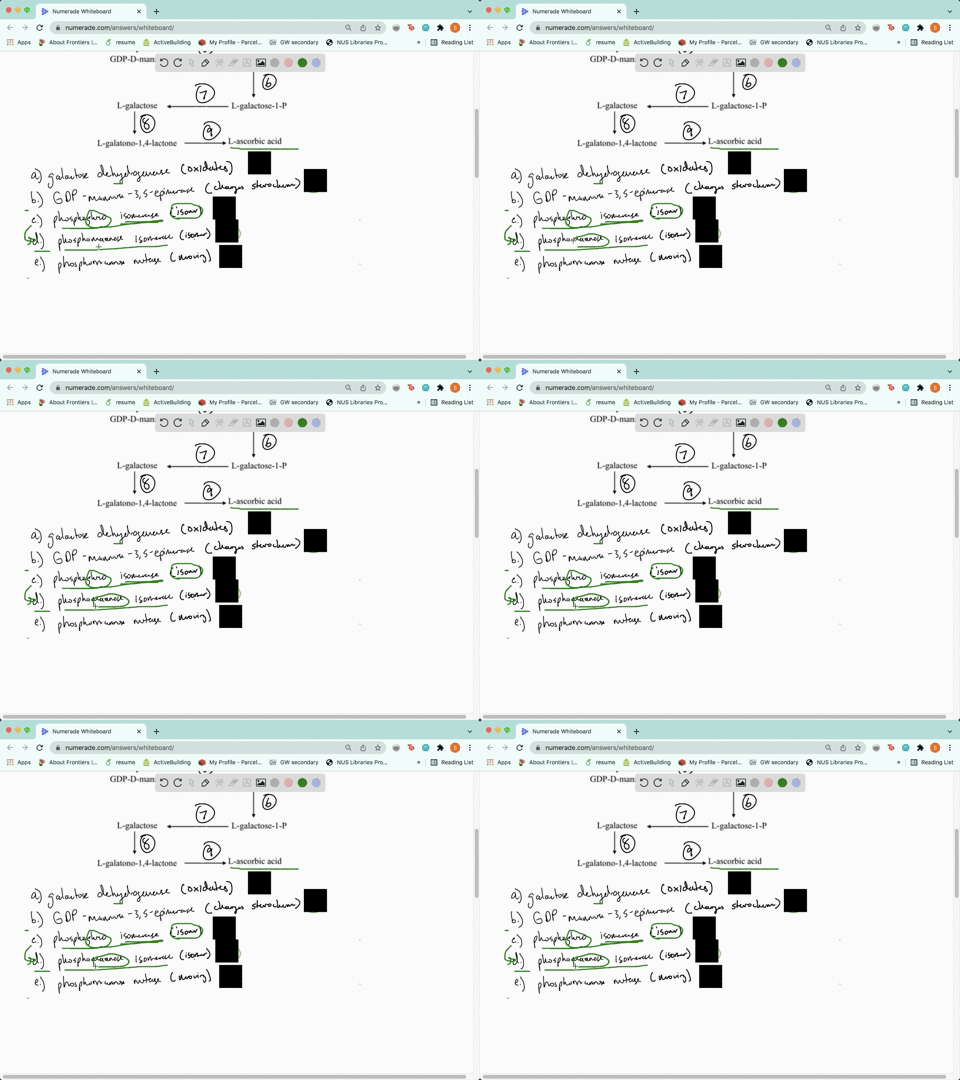
A proposed pathway for ascorbic acid (vitamin
C) biosynthesis in plants takes the form D-glucose- 6 -phosphate $\stackrel{1}{\longrightarrow}$ D-fructose- 6 -phosphate $\stackrel{2}{\longrightarrow}$ D-mannose-6-phosphate $\longrightarrow$ D-mannose-1-phosphate 4
GDP-D-mannose $\stackrel{5}{\longrightarrow}$ GDP-L-galactose $\stackrel{6}{\longrightarrow}$ L-galactose-1-phosphate $\frac{7}{9}$ L-galactose L-galactono-1,4-lactone ? L-ascorbic acid
Match each of the following enzymes to one of the pathway steps.
(a) galactose dehydrogenase
(b) GDP-mannose-3,5-epimerase
(c) phosphoglucose isomerase
(d) phosphomannose isomerase
(e) phosphomannose mutase

Chapter 15: Glucose Catabolism
Sydney Reibschied
02:22
Biology

The development of offspring from unfertilized eggs is
a. budding.
b. cloning.
c. fragmentation.
d. parthenogenesis.
e. implantation.

Chapter 51: Animal Reproduction
Sydney Reibschied
02:05
Biology

Which is considered an advantage of sexual reproduction?
a. necessity to locate a mate
b. increased energy expenditure in producing gametes that may not be used in reproduction
c. increased genetic variation
d. decreased genetic variation
e. both a and b

Chapter 51: Animal Reproduction
Sydney Reibschied
01:45
Biology

Spermatogonia
a. are haploid germ cells.
b. are mature haploid cells.
c. are male gametes.
d. have flagella.
e. are diploid germ cells.

Chapter 51: Animal Reproduction
Sydney Reibschied
02:36
Biology

Compared with external fertilization, in internal fertilization,
a. male gametes have a higher chance to come into close proximity to female gametes.
b. gametes are less protected against predation or other harmful environmental factors.
c. there is a decreased likelihood of desiccation of gametes.
d. gametes come into contact only outside the mother's reproductive tract.
e. Both b and c are true of internal fertilization.

Chapter 51: Animal Reproduction
Sydney Reibschied
1 2 3 4 5 ... 8

Sydney's Quick Ask Videos

01:19
Organic Chemistry

CH3CNHSH add unshared lone pairs to structure

Sydney Reibschied
01:56
Biology

List and explain four processes mitosis is responsible for in
living organisms. These processes are not the phases of
mitosis!!!

Sydney Reibschied
03:08
Biology

Which of the following is the best definition for
CRISPR-Cas9
a system that cuts DNA in random places
A system that uses small guide RNAs to bind target DNA and guide
the sequence-specific cutting of target DNA
a system that uses small guide RNAs to bind to target DNA and
guide the random cutting of target DNA
a system that uses small guide RNAs to insert DNA into
target DNA sequences

Sydney Reibschied
03:38
Biology

How do mutations change the chemical nature of the R group of amino acids? (such as polar, nonpolar, charged, uncharged) Can we predict if these changes strongly affect the protein function or only have weak effects?
a) Glutamate to lysine
b) Asparagine to tyrosine
c) Aspartate to glutamate

Sydney Reibschied
01:49
Biology

The secondary structure of proteins is Stabilization by the formation of ( ) bonds between peptide bonds.

Sydney Reibschied
02:47
Biology

When your body temperature drops below normal, your muscles
begin to contract rapidly, making you shiver and generating heat.
In this case your muscle organs are:
Select one:
a. the effector
b. the sensor
c. the response
d. the control center
e. the stimulus

Sydney Reibschied
1 2 3 4 5 ... 32