I am a dedicated student-athlete at Washington College going into my senior year. I am a Biochemistry and Molecular Biology major, and I have a very strong understanding of all things biology. I currently have a 3.6 GPA, and am in San Francisco at the University of California, San Francisco, assisting in a research project on the prevention of cancerous tumor metastasis, before I head back to Maryland at Washington College for my senior year. I have thought before in course mentoring sessions and tutoring, and have experience helping people in the sciences
RNA polymerases carry out transcription at a much Iower rate than that at which DNA polymerases carry out replication. Why is speed more important in replication than in transcription?
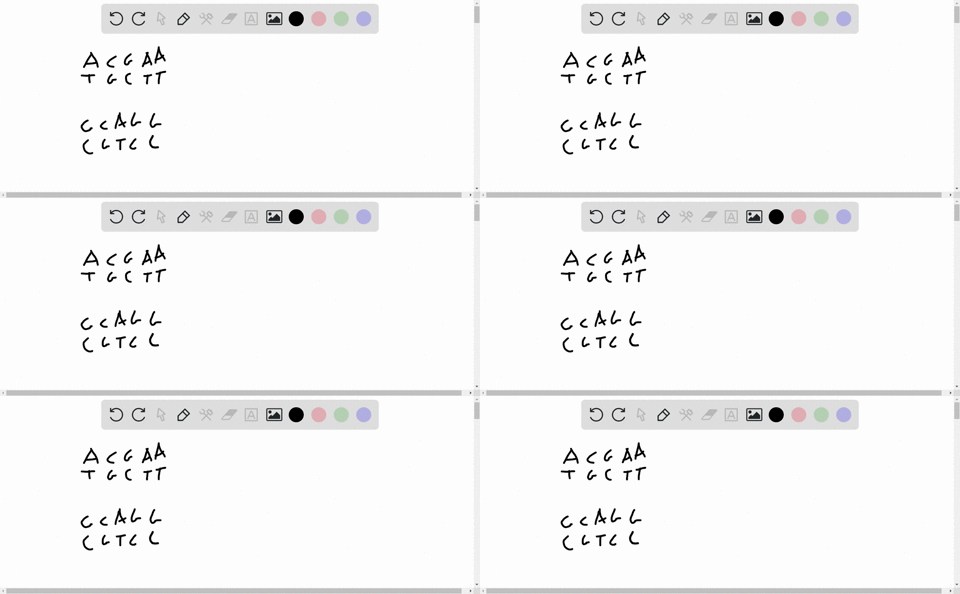
Write the consensus sequence for the following set of nudeotide sequences. AGGAGIT AGCTATT TGCAATA ACGAAAA TCCTAAT TGCAATT.
Although most salamanders have four legs, a few species that live in shallow water lack hind limbs and have extremely tiny forelimbs (see photograph). Develop a hypothesis to explain how limbless salamanders came about according to Darwin's mechanism of evolution by natural selection. How could you test your hypothesis?
A small block slides in the interior of a smooth semicircular cylinder after being released from rest at the upper corner $A$. Because friction is negligible, the speed of the block is given by $v^2=2 g h$, where $h$ is the vertical distance the block has fallen. Determine the velocity and acceleration of the block as a function of $h$. Then sketch the acceleration when $h=R / 2$.Figure can't copy
Both DNA and RNA are nucleic acids. Which of the following statements is true with regard to how these macromolecules differ from each other?A) How stupid do you think I look? It's like so obvious. They are spelled differently. The "D" in DNA stands for Dull and the "R" in RNA stands for Radically awesome.B) Chemically, they are indistinguishable from each other. Their differences are primarily in their structural nature where DNA typically exists as a double-stranded molecule while RNA typically exists in a single-stranded state.C) The major difference between DNA and RNA is the presence of an extra hydroxyl group on the 2' carbon of DNA and the use of uracil in place of thymine in RNA. Beyond this, the chemical and structural characteristics of these two molecules are the same.D) Nitrogenous bases in DNA are held together along a backbone of deoxyribose sugars and phosphates while nitrogenous bases in RNA are held together along a backbone of phosphates and ribose sugars.E) The thermodynamic parameters of individual base pair interactions are identical, but RNA's tendency to fold into stable secondary structure increases its ΔG (Gibbs Free Energy) value compared to DNA.
1. Both DNA and RNA are nucleic acids, but why do weuse PCR to amplify DNA not RNA most of the time?A. There is no RNA polymeraseB. RNA cannot be amplifiedC. DNA is much more stable than RNAD. RNA can only be single-stranded2. What is the role of the Taq DNA polymerase in a PCRreaction? A. Adding nucleotides to the 3' end of a DNA strandB. Providing the energy to denature the DNA and separatingDNA strandsC. Adding new DNA strands to the older onesD. Adding nucleotides to the 5' end of a DNAstrand3. What is the annealing temperature step duringPCR?A. 72 °CB. It depends on the length and sequence of primer pairsC. 37 °CD. 50°C
1. A solution of lemon juice has a pH of 2 and milk has a pH of 6. The hydrogen ion concentration of lemon juice is ____ than the hydrogen ion concentration of milk. a. 4 times greater b. 10,000 times lower c. 400 times greater d. 10,000 times greater 2. Some viruses consist only of a protein coat surrounding a nucleic acid core. If you wanted to radioactively label the nucleic acids separately from the protein you would use radioactive _____ a. phosphorus b. carbon c. sulfur d. nitrogen 3. Regulation of gene expression involves _____ a. none of the choices are correct b. positive control c. both positive and negative control d. negative control 4. In E.coli, the lac operon should be fully expressed (turned on) ____ a. all the time b. when there is glucose and no lactose present c. when there is lactose and no glucose present d. when there is both lactose and glucose present 5. Which of the following molecules are necessary for DNA replication within cells, but NOT amplification of DNA via polymerase chain reaction (PCR)? a. DNA polymerase b. Primers c. Nucleotides d. Helicase
Which of the following best describes the difference between prokaryotic and eukaryotic genes? - Prokaryotic genes are transcribed by RNA polymerase, eukaryotic genes are transcribed by DNA polymerase. - Prokaryotic genes are always much shorter than eukaryotic genes. - Prokaryotic genes are found in the cytoplasm, eukaryotic genes are found in the nucleus. - The coding region of prokaryotic genes is not disrupted by introns, while the coding region of eukaryotic genes is disrupted by introns.
If the sequence of a DNA template is: 5'-ATGTGTATGCGCGTAGCGA-3', in which direction will transcription occur? - Left to right - Right to left
Flower colour in hibiscus plants is determined by one gene thathas two different alleles. A true-breeding plant with red flowersis crossed with a true-breeding plant with white flowers (Pgeneration). The F1 offspring all have variegated flowers (patchesof red and white). When the F1 variegated plants are crossed, theF2 generation had 6 red-flowered plants, 5 white-flowered plants,and 12 plants with variegated flowersA. Provide the genotypes of the individuals in the P generation,F1 generation, and F2 generation.B. What are the genotypic and phenotypic ratios in the F2generation?C. What type of dominance exists between the twoalleles?
Explain why beta-sheets are less likely to form thanalpha helix in the earliest stages of protein folding (2marks).