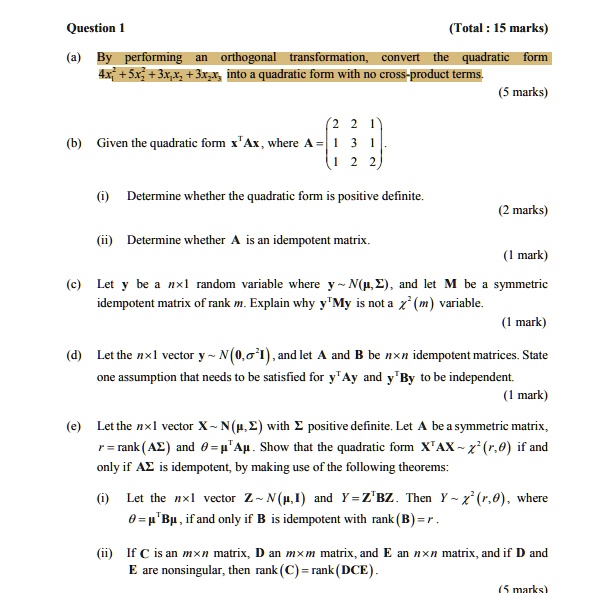
Question 1
(Total: 15 marks)
(a) By performing an orthogonal transformation, convert the quadratic form
$4x_1^2 + 5x_2^2 + 3x_1x_2 + 3x_2x_1$ into a quadratic form with no cross-product terms.
(5 marks)
$\begin{pmatrix} 2 & 2 & 1 \\ 1 & 3 & 1 \\ 1 & 2 & 2 \end{pmatrix}$
(b) Given the quadratic form $x^TAx$, where $A =
(i) Determine whether the quadratic form is positive definite.
(2 marks)
(ii) Determine whether A is an idempotent matrix.
(1 mark)
(c) Let y be a $n \times 1$ random variable where $y \sim N(\mu, \Sigma)$, and let M be a symmetric
idempotent matrix of rank m. Explain why $y^TMy$ is not a $\chi^2(m)$ variable.
(1 mark)
(d) Let the $n \times 1$ vector $y \sim N(0, \sigma^2I)$, and let A and B be $n \times n$ idempotent matrices. State
one assumption that needs to be satisfied for $y^TAy$ and $y^TBy$ to be independent.
(1 mark)
(e) Let the $n \times 1$ vector $X \sim N(\mu, \Sigma)$ with $\Sigma$ positive definite. Let A be a symmetric matrix,
$r = rank(\Sigma A)$ and $\theta = \mu^T A \mu$. Show that the quadratic form $X^TAX \sim \chi^2(r, \theta)$ if and
only if $\Sigma A$ is idempotent, by making use of the following theorems:
(i) Let the $n \times 1$ vector $Z \sim N(\mu, I)$ and $Y = Z^TBZ$. Then $Y \sim \chi^2(r, \theta)$, where
$\theta = \mu^TB\mu$, if and only if B is idempotent with rank(B) = r.
(ii) If C is an $m \times n$ matrix, D an $m \times m$ matrix, and E an $n \times n$ matrix, and if D and
E are nonsingular, then rank(C) = rank(DCE).
(5 marks)