6. Private Health Insurance Market
(a) During the George W. Bush administration, the marginal tax rate on wage income climbed substantially. For
example, the top rate was raised from 28 to 40 percent. Calculate the value of health insurance for workers who
are subjected to the top tax rate both before and after the policy change. Based on your calculation, use the
theory of demand to predict how tax-increase affect the quantity demanded for employer-sponsored health
insurance among high-wage workers.
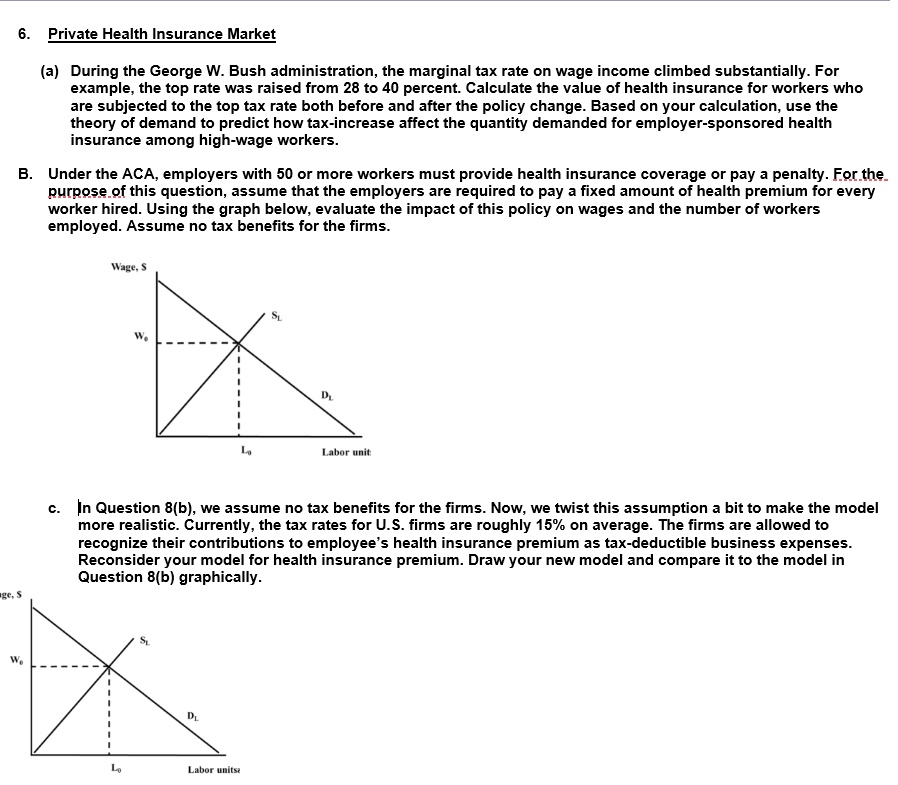
B. Under the ACA, employers with 50 or more workers must provide health insurance coverage or pay a penalty. For the
purpose of this question, assume that the employers are required to pay a fixed amount of health premium for every
worker hired. Using the graph below, evaluate the impact of this policy on wages and the number of workers
employed. Assume no tax benefits for the firms.
Wage, S
Wo
Wage, S
SL
Wo
DL
Lo
Labor unit
c. In Question 8(b), we assume no tax benefits for the firms. Now, we twist this assumption a bit to make the model
more realistic. Currently, the tax rates for U.S. firms are roughly 15% on average. The firms are allowed to
recognize their contributions to employee's health insurance premium as tax-deductible business expenses.
Reconsider your model for health insurance premium. Draw your new model and compare it to the model in
Question 8(b) graphically.
SL
DL
Lo
Labor units