Let Q(x, y) be the predicate "If x < y then $x^2 < y^2$", with domain for both x and y being R, the set of all real numbers.
(a) When x = -2 and y = 1, is Q(x, y) true or false?
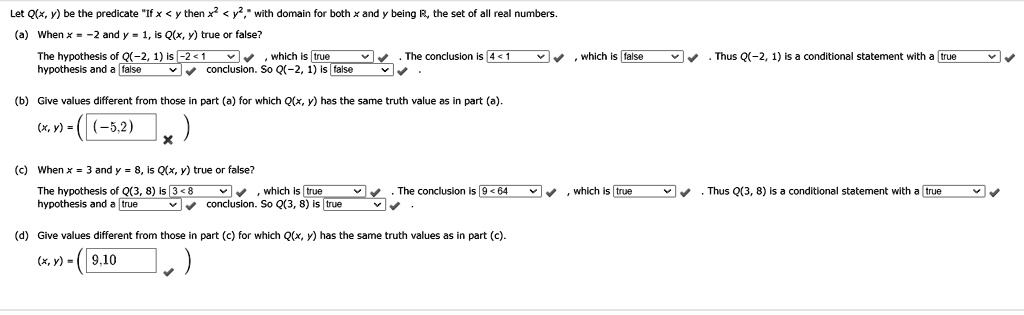
The hypothesis of Q(-2, 1) is -2 < 1, which is true
The conclusion is $4 < 1$, which is false. Thus Q(-2, 1) is a conditional statement with a true hypothesis and a false conclusion. So Q(-2, 1) is false.
(b) Give values different from those in part (a) for which Q(x, y) has the same truth value as in part (a).
(x, y) = (-5, 2)
(c) When x = 3 and y = 8, is Q(x, y) true or false?
The hypothesis of Q(3, 8) is 3 < 8, which is true
The conclusion is $9 < 64$, which is true. Thus Q(3, 8) is a conditional statement with a true hypothesis and a true conclusion. So Q(3, 8) is true.
(d) Give values different from those in part (c) for which Q(x, y) has the same truth values as in part (c).
(x, y) = (9, 10)