Ace - AI Tutor
Ask Our Educators
Textbooks
My Library
Flashcards
Scribe - AI Notes
Notes & Exams
Download App

Divider

Questions asked

INSTANT ANSWER

If the market rate is 9%, calculate the issue price.(FV of $1, PV of $1, FVA of $1, and PVA of $1) (Use appropriate factor(s) from the tables provided. Enter your answers in dollars not in millions (i.e., $5.5 million should be entered as 5,500,000). Round your final answers to the nearest whole dollar.)

View Answer
divider
INSTANT ANSWER

The National Collegiate Athletic Association (NCAA) measures the Graduation Success Rate (GSR), which is the percentage of eligible athletes who graduate within six years of entering college. According to the NCAA, the GSR for all scholarship athletes in a particular division is \( 63 \% \). The GSR for all students in this division is \( 59 \% \). Complete parts a and \( \mathbf{b} \). a. Suppose the NCAA report was based on a sample of 500 student-athletes, of which 315 graduated within six years. Is this sufficient information to conclude that the GSR for all scholarship athletes in this division differs from \( 59 \% \) ? Test using \( \alpha=0.01 \). What are the hypotheses for this test? A. \( H_{0}: p=0.59 ; H_{a}: p \neq 0.59 \) B. \( H_{0}: p \neq 0.59 ; H_{a}: p=0.59 \) c. \( H_{0}: p=0.59 ; H_{a}: p<0.59 \) D. \( H_{0}: p=0.59 ; H_{a}: p>0.59 \) Find the rejection region for the test. Choose the correct answer below. A. \( z<-2.575 \) B. \( z<-2.33 \) or \( z>2.33 \) c. \( z>2.575 \) D. \( z>2.33 \) E. \( z<-2.33 \) F. \( z<-2.575 \) or \( z>2.575 \) Calculate the value of the test statistic. \( z= \) \( \square \) (Round to two decimal places as needed.)

View Answer
divider
ANSWERED

Breanna Ollech verified

Numerade educator

Suppose 39 women used a skin cream for 22 weeks. At the end of the period a dermatologist judged whether each women exhibited skin imporvement

View Answer
divider
INSTANT ANSWER

Answer Pages: Show any work that you wish to be graded as well as your answers in the spaces below. Please note, JMP may be used to calculate probabilities. 1) a. Property \#1: \( \qquad \) Property \#2: \( \qquad \) b. The probabality that a randomly selected policatholder files three clains \( P(x=3)=0.04 \) c. The probability that a randomly selected Palicuholdes files more than one claim \( P(x>1)=P(2)+P(3)+(4) \) \( =0.07+0.04+0.01=0.12 \) d. The probabitaty that a pandomly seleoted Pdiacholder fles at most two clains \( 0.50 .95 \quad 0.72+0.016+0.07=0.95 \) c. Mean \( =0.42 \) Standard Deviation \( =0.8623 \) \( \qquad \) \( \qquad \)

View Answer
divider
ANSWERED

Lucas Finney verified

Numerade educator

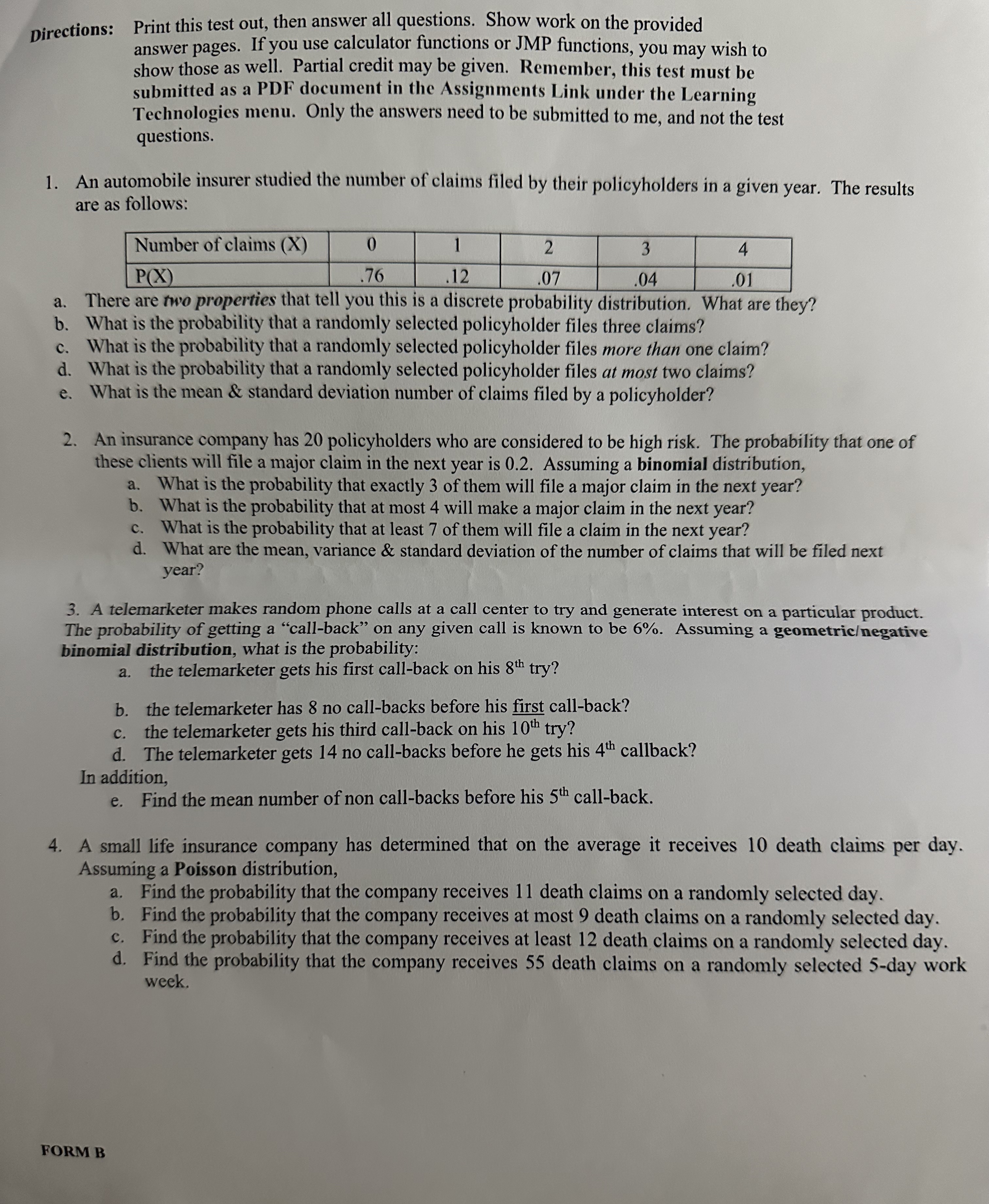
Directions: Print this test out, then answer all questions. Show work on the provided answer pages. If you use calculator functions or JMP functions, you may wish to show those as well. Partial credit may be given. Remember, this test must be submitted as a PDF document in the Assignments Link under the Learning Technologies menu. Only the answers need to be submitted to me, and not the test questions. 1. An automobile insurer studied the number of claims filed by their policyholders in a given year. The results are as follows: Number of claims (X) 0 1 2 3 4 P(X) .76 .12 .07 .04 .01 a. There are two properties that tell you this is a discrete probability distribution. What are they? b. What is the probability that a randomly selected policyholder files three claims? c. What is the probability that a randomly selected policyholder files more than one claim? d. What is the probability that a randomly selected policyholder files at most two claims? e. What is the mean & standard deviation number of claims filed by a policyholder? 2. An insurance company has 20 policyholders who are considered to be high risk. The probability that one of these clients will file a major claim in the next year is 0.2. Assuming a binomial distribution, a. What is the probability that exactly 3 of them will file a major claim in the next year? b. What is the probability that at most 4 will make a major claim in the next year? c. What is the probability that at least 7 of them will file a claim in the next year? d. What are the mean, variance & standard deviation of the number of claims that will be filed next year? 3. A telemarketer makes random phone calls at a call center to try and generate interest on a particular product. The probability of getting a "call-back" on any given call is known to be 6%. Assuming a geometric/negative binomial distribution, what is the probability: a. the telemarketer gets his first call-back on his 8th try? b. the telemarketer has 8 no call-backs before his first call-back? c. the telemarketer gets his third call-back on his 10th try? d. The telemarketer gets 14 no call-backs before he gets his 4th callback? In addition, e. Find the mean number of non call-backs before his 5th call-back. 4. A small life insurance company has determined that on the average it receives 10 death claims per day. Assuming a Poisson distribution, a. Find the probability that the company receives 11 death claims on a randomly selected day. b. Find the probability that the company receives at most 9 death claims on a randomly selected day. c. Find the probability that the company receives at least 12 death claims on a randomly selected day. d. Find the probability that the company receives 55 death claims on a randomly selected 5-day work week.
View Answer
divider
INSTANT ANSWER

4. Null Hypothesis: \[ H_{o}: p_{1}-p_{2}=0 \] Alt.Hypothesis: \( H_{a}: p_{1}-p_{2} \) \( \qquad \) 0 Pop \#1: \( \qquad \) Pop \#2: \( \qquad \) \( \mathrm{n}_{1}= \) \( \qquad \) \( \mathrm{n}_{2}= \) \( \qquad \) \( \mathrm{x}_{1}= \) \( \qquad \) ? \[ p_{1}= \] \( \qquad \) \[ \mathrm{x}_{2}= \] \( \qquad \) \( \wedge \) \( p_{2}= \) \( \qquad \) Decision Rule: We will reject the Null Hypothesis, \( \mathrm{H}_{0} \), if the testing statistic is \[ \text { t.s. }=\frac{\left(\hat{p_{1}}-\hat{p_{2}}\right)-\mu_{\hat{p_{1}}-\hat{p_{2}}}}{s_{\hat{\hat{p}_{1}}-\hat{p_{2}}}} \] (where \( s_{\hat{p_{1}-\hat{p}_{2}}}=\sqrt{\hat{p} q\left(\frac{1}{n_{1}}+\frac{1}{n_{2}}\right)} \) Result of test : \( \qquad \) Final Conclusion: Based on the given information... \( \qquad \) \( \qquad \) \( \qquad \) \[ z_{c}= \]

View Answer
divider
ANSWERED

Keondre Parker verified

Numerade educator

4b. Confidence interval for the difference between two population proportions: [ (hat{p}_1 - hat{p}_2) - z_c cdot sigma_{hat{p}_1 - hat{p}_2} < p_1 - p_2 < (hat{p}_1 - hat{p}_2) + z_c cdot sigma_{hat{p}_1 - hat{p}_2} ] where, $sigma_{hat{p}_1 - hat{p}_2} = sqrt{frac{p_1 q_1}{n_1} + frac{p_2 q_2}{n_2}}$ Interpretation:

View Answer
divider
INSTANT ANSWER

4. Null Hypothesis: Alt.Hypothesis: Pop \#1: \( \qquad \) \( \mathrm{n}_{1}= \) \( \qquad \) \( \mathrm{x}_{1}= \) \( \qquad \) ? \( p_{1}= \) \( \qquad \) Pop \#2: \( \qquad \) \( \mathrm{n}_{2}= \) \( \qquad \) \( H_{o}: p_{1}-p_{2}=0 \) \( H_{a}: p_{1}-p_{2} \longrightarrow 0 \) \( H_{a}: p_{1}-p_{2} \) \( t . s .=\frac{\left(\hat{p}_{1}-\hat{p}_{2}\right)-\mu_{\hat{A}-\hat{p}_{2}}}{s_{\hat{A}-\hat{p}_{2}}} \) Pooled Sample Proportion: \( \hat{p}=\frac{x_{1}+x_{2}}{n_{1}+n_{2}}= \) \( \qquad \) Distribution: Normal \( \alpha= \) \( \qquad \) p-value: \( \qquad \) \[ a_{c}= \] Decision Rule: We will reject the Null Hypothesis, \( \mathrm{H}_{0} \), if the lesting statistic is \( \qquad \) (where \( s_{\hat{n}_{1}-\hat{p}_{2}}=\sqrt{\hat{p} q\left(\frac{1}{n_{1}}+\frac{1}{n_{2}}\right)} \) Result of test : \( \qquad \) Final Conclusion: Based on the given information... \( \qquad \) \( \qquad \) \( \qquad \)

View Answer
divider
ANSWERED

Keondre Parker verified

Numerade educator

1b. 2-Sample t-Confidence Interval: [ left(ar{x}_{1}-ar{x}_{2} ight)-t_{c} cdot s_{ar{x}_{1}-ar{x}_{2}}<mu_{1}-mu_{2}<left(ar{x}_{1}-ar{x}_{2} ight)+t_{c} cdot s_{ar{x}_{1}-ar{x}_{2}} ] where, [ s_{ar{x}_{1}-ar{x}_{2}}=sqrt{frac{left(n_{1}-1 ight) s_{1}^{2}+left(n_{2}-1 ight) s_{2}^{2}}{n_{1}+n_{2}-2}left(frac{1}{n_{1}}+frac{1}{n_{2}} ight)} ] Interpretation:

View Answer
divider
ANSWERED

Breanna Ollech verified

Numerade educator

Place your answers on the following answer pages. Show work. Decision Rule: We will reject the Null Hypothesis, H?, if the testing statistic is ___________________ ___________________ 1. Null Hypothesis: H? : ?? – ?? = 0 Alt. Hypothesis: H? : ?? – ?? ___ 0 Pop #1: _________ Pop#2: _________ n? = _________ n? = _________ x?? = _________ x?? = _________ s? = _________ s? = _________ ? = _________ Distribution: t-dist df = n? + n? - 2 = _________ t? = _________ p-value: _________ t.s. = (x?? - x??) – (?? – ??) / s_(x?? - x??) = where s_(x?? - x??) = ?[ ((n? - 1)s?² + (n? - 1)s?²) / (n? + n? - 2) * (1/n? + 1/n?) ] = Result of test : __________________________________________ Final Conclusion: Based on the given information... __________________________________________ __________________________________________ __________________________________________

View Answer
divider