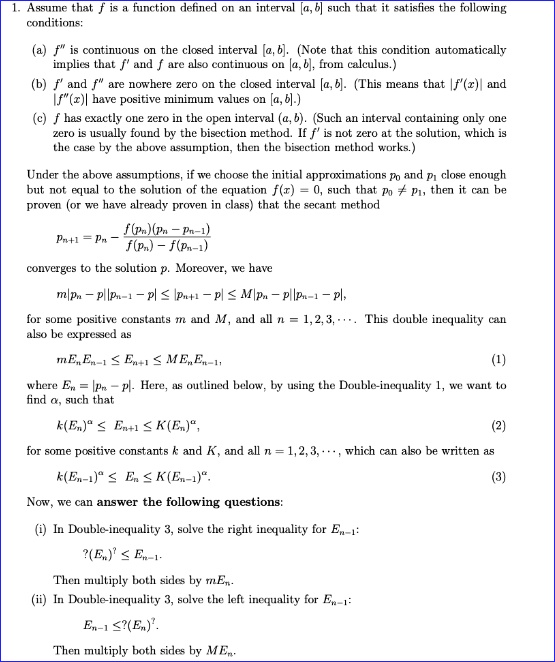
Assume that f is a function defined on an interval [a,b] such that it satisfies the following conditions:
(a) f is continuous on the closed interval [a,b]. (Note that this condition automatically implies that f' and f'' are also continuous on [a,b], from calculus.)
(b) f and f' are nowhere zero on the closed interval [a,b]. (This means that |f(a)| and |f(b)| have positive minimum values on [a,b].)
(c) f has exactly one zero in the open interval (a,b). (Such an interval containing only one zero is usually found by the bisection method. If f is not zero at the solution, which is the case by the above assumption, then the bisection method works.)
Under the above assumptions, if we choose the initial approximations p0 and p1 close enough but not equal to the solution of the equation f(x)=0, such that p0 < p1, then it can be proven (or we have already proven in class) that the secant method
pn+1 = pn - f(pn) * (pn - pn-1) / (f(pn) - f(pn-1))
converges to the solution p. Moreover, we have
|f'(pn)| > |f''(pn)| > |f'''(pn)| > ...
for some positive constants m and M, and all n = 1,2,3,... This double inequality can also be expressed as
m|En| < |En+1| < M|En|, (1)
where En = pn - p. Here, as outlined below, by using the Double-inequality 1, we want to find δ > 0, such that
k(En) < |En+1| < K(En), (2)
for some positive constants k and K, and all n = 1,2,3,..., which can also be written as
|En-1| < En < K|En-1|. (3)
Now, we can answer the following questions:
(i) In Double-inequality 3, solve the right inequality for En-1: |En-1| < K|En|.
Then multiply both sides by m|En|.
(ii) In Double-inequality 3, solve the left inequality for En-1:
|En-1| < |En|.
Then multiply both sides by M|En|.