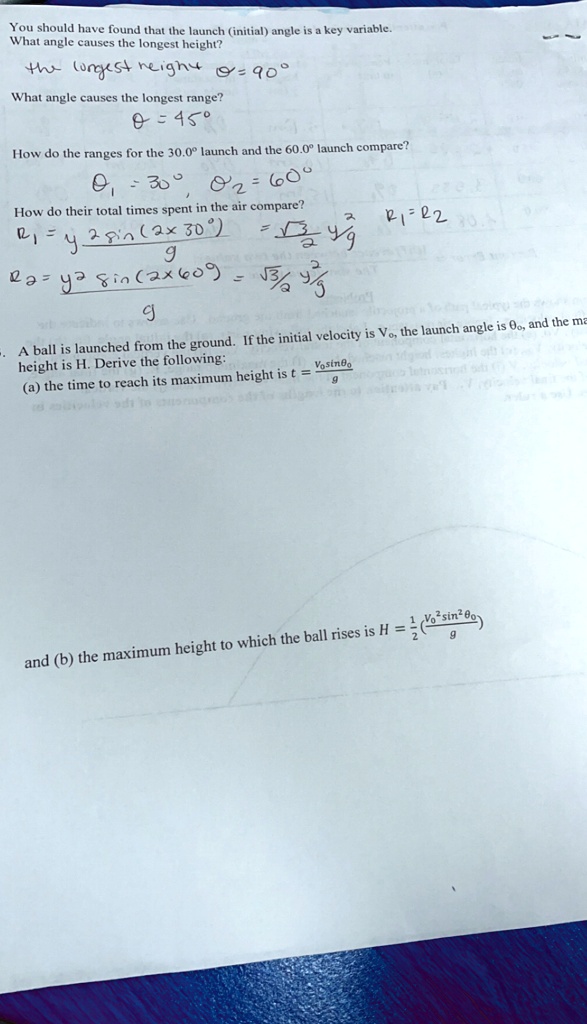
You should have found that the launch (initial) angle is a key variable.
What angle causes the longest height?
the longest height $\theta = 90^\circ$
What angle causes the longest range?
$\theta = 45^\circ$
How do the ranges for the 30.0° launch and the 60.0° launch compare?
$\theta_1 = 30^\circ$, $\theta_2 = 60^\circ$
How do their total times spent in the air compare?
$R_1 = \frac{y_0^2 \sin(2 \times 30^\circ)}{g} = \sqrt{3}/2 \frac{y_0^2}{g}$
$R_2 = \frac{y_0^2 \sin(2 \times 60^\circ)}{g} = \sqrt{3}/2 \frac{y_0^2}{g}$
$R_1 = R_2$
A. A ball is launched from the ground. If the initial velocity is $V_0$, the launch angle is $\theta_0$, and the ma
height is H. Derive the following:
(a) the time to reach its maximum height is $t = \frac{V_0 \sin \theta_0}{g}$
and (b) the maximum height to which the ball rises is $H = \frac{1}{2} (\frac{V_0^2 \sin^2 \theta_0}{g})$