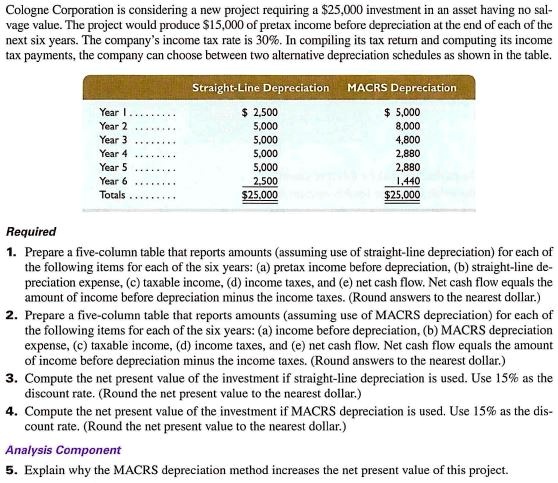
Cologne Corporation is considering a new project requiring a $25,000 investment in an asset having no sal-
vage value. The project would produce $15,000 of pretax income before depreciation at the end of each of the
next six years. The company's income tax rate is 30%. In compiling its tax return and computing its income
tax payments, the company can choose between two alternative depreciation schedules as shown in the table.
Straight-Line Depreciation
MACRS Depreciation
Year I
$ 2,500
$ 5,000
Year 2
5,000
8,000
Year 3
5,000
4,800
Year 4
5,000
2,880
Year 5
5,000
2,880
Year 6
2,500
1,440
Totals
$25,000
$25,000
Required
1. Prepare a five-column table that reports amounts (assuming use of straight-line depreciation) for each of
the following items for each of the six years: (a) pretax income before depreciation, (b) straight-line de-
preciation expense, (c) taxable income, (d) income taxes, and (e) net cash flow. Net cash flow equals the
amount of income before depreciation minus the income taxes. (Round answers to the nearest dollar.)
2. Prepare a five-column table that reports amounts (assuming use of MACRS depreciation) for each of
the following items for each of the six years: (a) income before depreciation, (b) MACRS depreciation
expense, (c) taxable income, (d) income taxes, and (e) net cash flow. Net cash flow equals the amount
of income before depreciation minus the income taxes. (Round answers to the nearest dollar.)
3. Compute the net present value of the investment if straight-line depreciation is used. Use 15% as the
discount rate. (Round the net present value to the nearest dollar.)
4. Compute the net present value of the investment if MACRS depreciation is used. Use 15% as the dis-
count rate. (Round the net present value to the nearest dollar.)
Analysis Component
5. Explain why the MACRS depreciation method increases the net present value of this project.