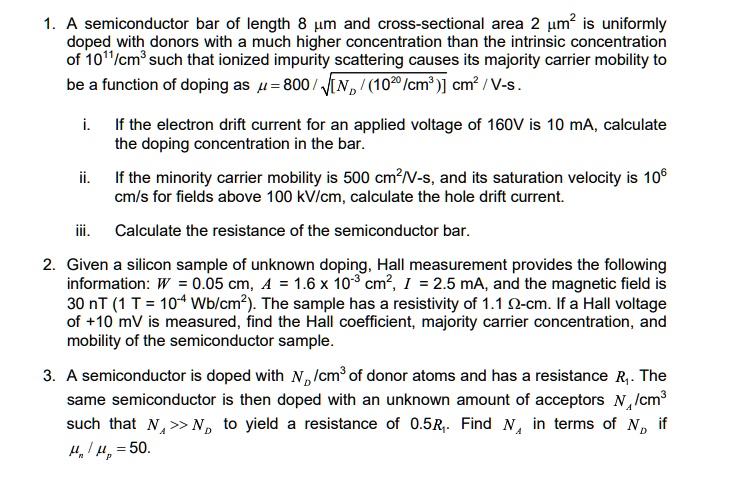
A semiconductor bar of length 8 m and cross-sectional area 2 m^2 is uniformly doped with donors with a much higher concentration than the intrinsic concentration of 10^11/cm^3 such that ionized impurity scattering causes its majority carrier mobility to be a function of doping as = 800 / [N/(10^2/cm^3)] cm^2/V-s.
i. If the electron drift current for an applied voltage of 160V is 10 mA, calculate the doping concentration in the bar.
1i. If the minority carrier mobility is 500 cm^2/V-s, and its saturation velocity is 10^6 cm/s for fields above 100 kV/cm, calculate the hole drift current.
ii. Calculate the resistance of the semiconductor bar.
2. Given a silicon sample of unknown doping, Hall measurement provides the following information: W = 0.05 cm, A = 1.6 x 10^-4 cm, I = 2.5 mA, and the magnetic field is 30 nT (1 T = 10^-4 Wb/cm^2). The sample has a resistivity of 1.1 Ω-cm. If a Hall voltage of +10 mV is measured, find the Hall coefficient, majority carrier concentration, and mobility of the semiconductor sample.
3. A semiconductor is doped with N_donor/cm of donor atoms and has a resistance R_initial. The same semiconductor is then doped with an unknown amount of acceptors N_acceptor/cm such that N_acceptor >> N_donor to yield a resistance of 0.5R_initial. Find N_acceptor in terms of N_donor if β = 50.