Problem 1: Short Answer (25 points)
Part A
Later in CVEN-3313, we will learn how changes in fluid velocity ($\Delta V$) translate into forces ($F$).
Which of the following equations is correct and why? $F = \rho Q \Delta V$, or $F = \gamma Q \Delta V$?
Part B
Let us define molar density $\rho_n$ with units of [mol/m³], where mol = mole = $6.02 \times 10^{23}$ molecules.
Starting with the ideal gas law, derive an equation for molar density.
Part C
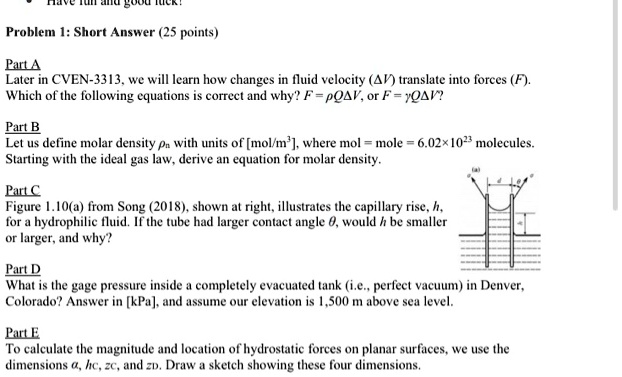
Figure 1.10(a) from Song (2018), shown at right, illustrates the capillary rise, $h$,
for a hydrophilic fluid. If the tube had larger contact angle $\theta$, would $h$ be smaller
or larger, and why?
Part D
What is the gage pressure inside a completely evacuated tank (i.e., perfect vacuum) in Denver,
Colorado? Answer in [kPa], and assume our elevation is 1,500 m above sea level.
Part E
To calculate the magnitude and location of hydrostatic forces on planar surfaces, we use the
dimensions $a$, $h_c$, $z_c$, and $z_D$. Draw a sketch showing these four dimensions.