Questions asked
The drive of this carbocation rearrangement is the conversion of a: Choose one:A. secondary carbocation to a tertiary carbocation.B. tertiary carbocation to a secondary carbocation.C. primary carbocation to a secondary carbocation.D. secondary carbocation to a primary carbocation.
18. EMS providers are stabilizing a conscious geriatric patient experiencing severe shortness of breath related to emphysema. They have applied high-flow oxygen via non-rebreather mask and confirm there is no ectopy on the cardiac monitor. What is their HIGHEST priority during transport? Positioning the patient left lateral recumbent. Administering racemic epinephrine via nebulizer. Establishing a peripheral IV of an isotonic solution. Delivery of an antipyretic medication intravenously.
Which of the following holds true for the transactional view of stress?
The appropriate form of the partial fraction decomposition for the following function is: (5x)/((x-7)^(2)(x^(2)+2)) = A/(x-7) + B/(x-7)^(2) + (Cx+D)/(x^(2)+2)
As an open economy, Canadian national saving can be less than Canadian investment. True or False?
5. What enzyme adds glucose molecules to the \alpha(1-6) position in glycogenesis? 6. What compound both ends and starts the Kreb cycle: a. Citrate b. Oxaloacetate c. Succinate d. $CO_2$ e. None of the above
Solve the ordinary differential equation $y - xy' = -x^3 \cos \frac{y}{x}$
Given the following reaction: B\(_2\)H\(_6\) + O\(_2\) \(\rightarrow\) HBO\(_2\) + H\(_2\)O (a) What theoretical mass of O\(_2\) will be needed to burn 36.1 g of B\(_2\)H\(_6\)? (b) What mass of O\(_2\) will be needed to burn 36.1 g of B\(_2\)H\(_6\) if O\(_2\) is 60% in excess? (c) What volume of 60% in excess air at 1 atm and 25 deg C is needed to burn 36.1 g of B\(_2\)H\(_6\)? (d) How many moles of water are produced from 36.1 g of B\(_2\)H\(_6\)?
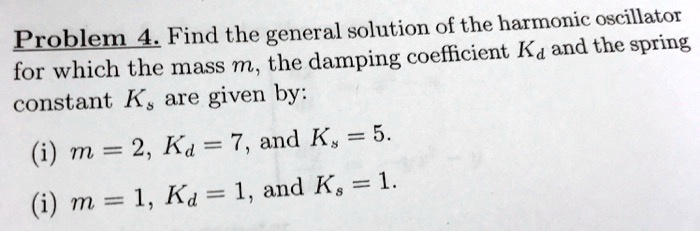
Problem 4. Find the general solution of the harmonic oscillator for which the mass $m$, the damping coefficient $K_d$ and the spring constant $K_s$ are given by: (i) $m = 2$, $K_d = 7$, and $K_s = 5$. (i) $m = 1$, $K_d = 1$, and $K_s = 1$.
3 Solve using inverse coefficient matrix: \{-x + y + 2z = 1 \{2x + 3y + z = -2 \{5x + 4y + 2z = 4