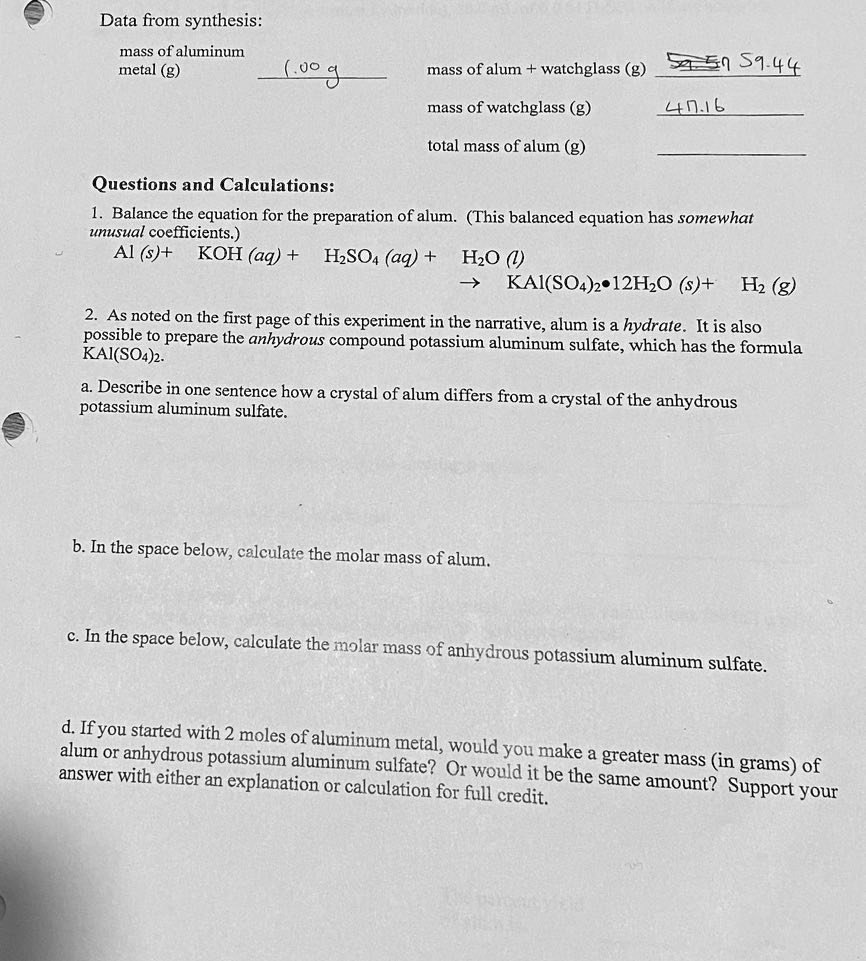
Data from synthesis:
mass of aluminum
metal (g)
1.00 g
mass of alum + watchglass (g) 59.44
mass of watchglass (g)
47.16
total mass of alum (g)
Questions and Calculations:
1. Balance the equation for the preparation of alum. (This balanced equation has somewhat
unusual coefficients.)
Al (s) + KOH (aq) + H$_2$SO$_4$ (aq) + H$_2$O (l) $\rightarrow$ KAl(SO$_4$)$_2$ \cdot 12H$_2$O (s) + H$_2$ (g)
2. As noted on the first page of this experiment in the narrative, alum is a hydrate. It is also
possible to prepare the anhydrous compound potassium aluminum sulfate, which has the formula
KAl(SO$_4$)$_2$.
a. Describe in one sentence how a crystal of alum differs from a crystal of the anhydrous
potassium aluminum sulfate.
b. In the space below, calculate the molar mass of alum.
c. In the space below, calculate the molar mass of anhydrous potassium aluminum sulfate.
d. If you started with 2 moles of aluminum metal, would you make a greater mass (in grams) of
alum or anhydrous potassium aluminum sulfate? Or would it be the same amount? Support your
answer with either an explanation or calculation for full credit.