Ace - AI Tutor
Ask Our Educators
Textbooks
My Library
Flashcards
Scribe - AI Notes
Notes & Exams
Download App
adri-n hawkins

adri-n h.

Divider

Questions asked

BEST MATCH

When VLANs span multiple switches ____________________________ is the best way to transport frames between the switches Question 1 options: a) a router between the switches b) using the VTP protocol c) a hub between the switches d) a trunk connection between the switches

View Answer
divider
BEST MATCH

Dr. Junger subscribes to Psychogenic Theory in order to find the causes for his patients' abnormalities. Which of the following statements from Dr. Junger BEST represents his belief in this theory? I believe that your public outbursts were most likely caused by a bad reaction to your new medication. I believe that your public outbursts were most likely caused by brain damage caused by your recent car accident. I believe that your public outbursts were most likely caused by an internal conflict between your ego and superego. I believe that your public outbursts were most likely caused by a case of untreated Lyme Disease. I believe that your public outbursts were most likely caused by a brain tumor.

View Answer
divider
BEST MATCH

Explain why the proper way to add 1 fractions. 5 + 3 5 and 2 5 + 4 5 makes sense, using our definition of

View Answer
divider
BEST MATCH

Keratangioma is a tumor of: a vessel of the cornea an artery of a horn(y growth) a vessel of the pupil a nerve of the choroid a vessel of the choroid

View Answer
divider
BEST MATCH

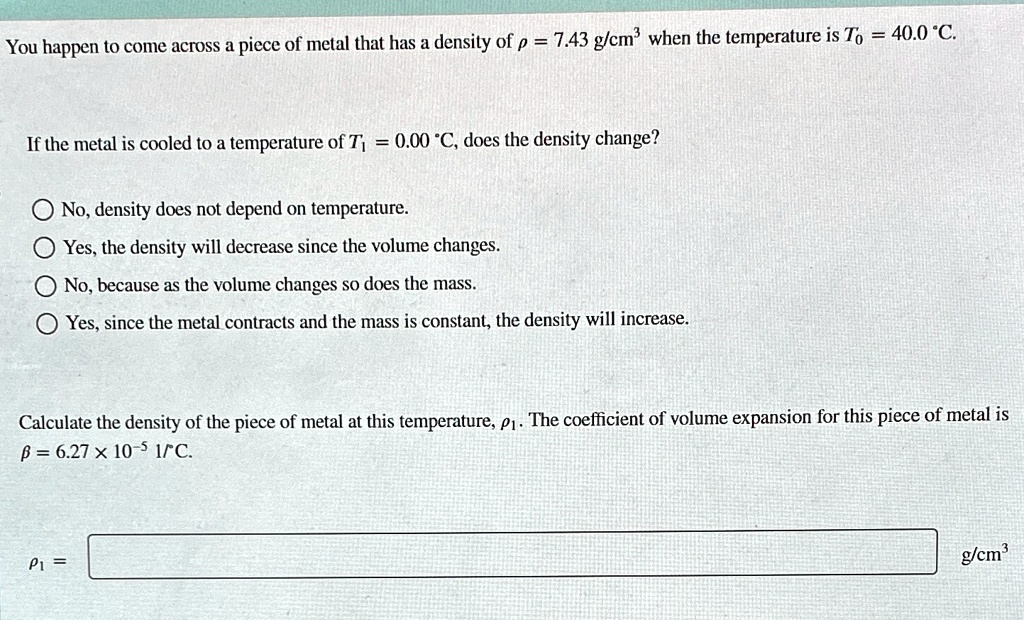
You happen to come across a piece of metal that has a density of $\rho$ = 7.43 g/cm$^3$ when the temperature is $T_0$ = 40.0 $^\circ$C. If the metal is cooled to a temperature of $T_1$ = 0.00 $^\circ$C, does the density change? No, density does not depend on temperature. Yes, the density will decrease since the volume changes. No, because as the volume changes so does the mass. Yes, since the metal contracts and the mass is constant, the density will increase. Calculate the density of the piece of metal at this temperature, $\rho_1$. The coefficient of volume expansion for this piece of metal is $\beta$ = 6.27 x 10$^{-5}$ 1/$^\circ$C. $\rho_1$ = g/cm$^3$
View Answer
divider
BEST MATCH

a. Find a CFG that generates the given language over the alphabet ? (SLO2) (15 pts) L = \{a^{2n} b^{2m+1} c^{n} | m, n \ge 0\}, \Sigma = \{a, b, c\}.

View Answer
divider
BEST MATCH

You are given a polar equation and its graph. Use the equation to determine polar coordinates of the points labeled with capital letters. (For the r-values, where necessary, use a calculator and round to two decimal places.) $r = \frac{4}{cos(\theta - \frac{\pi}{3})}$ A(r, $\theta$) = B(r, $\theta$) = C(r, $\theta$) = D(r, $\theta$) =

View Answer
divider
BEST MATCH

The centripetal force, F, acting on an object varies directly as the square of the speed (v) and inversely to the radius of its path. If the force is 100 Newtons when the object is traveling 10 m/s in a path of radius 0.5 m, what is the force when the object's speed increases to 25 m/s and the radius stays the same?

View Answer
divider
BEST MATCH

One way to build up our ideas about a solenoid is with a different problem. A non- conducting pipe with a thin wall has a radius of R and length L is spinning around the z axis: X Z y The outer surface of the nonconducting pipe carries a surface charge density of \sigma and spins about the z- axis at an angular velocity of \omega. Note that pipe extends an equal distance $\frac{L}{2}$ above and below the xy plane. a. Find the magnetic field along the z axis (so x = y = 0, but z can be anything inside or outside the pipe). b. Find the magnetic field in the xy plane for s > R, assume that s is sufficiently greater than R to treat this like a stack of dipoles. c. We'll now fill the inside of the pipe with a linear paramagnetic media of magnetic susceptibility \(\chi_m\) (it's inside, not outside and you can ignore the thickness of the cylinder). Assume that the charge density is still \sigma and the angular velocity is still \omega around the z axis. Find \(\vec{B}\), \(\vec{M}\) & \(\vec{H}\) inside and outside the pipe now. d. In the limit as L >> R show that we get back the solenoid expressions that we expect.

View Answer
divider
BEST MATCH

4) Consider the two-port network shown below: Port1 15 ? 36 ? Port2 500 ? 50 fF 200 ? 645 pH a) Derive [S] of the network at 28.025 GHz. (25 pts) b) Is the network lossless? Please justify. (10 pts) c) Is the network reciprocal? Please justify. (10 pts)

View Answer
divider