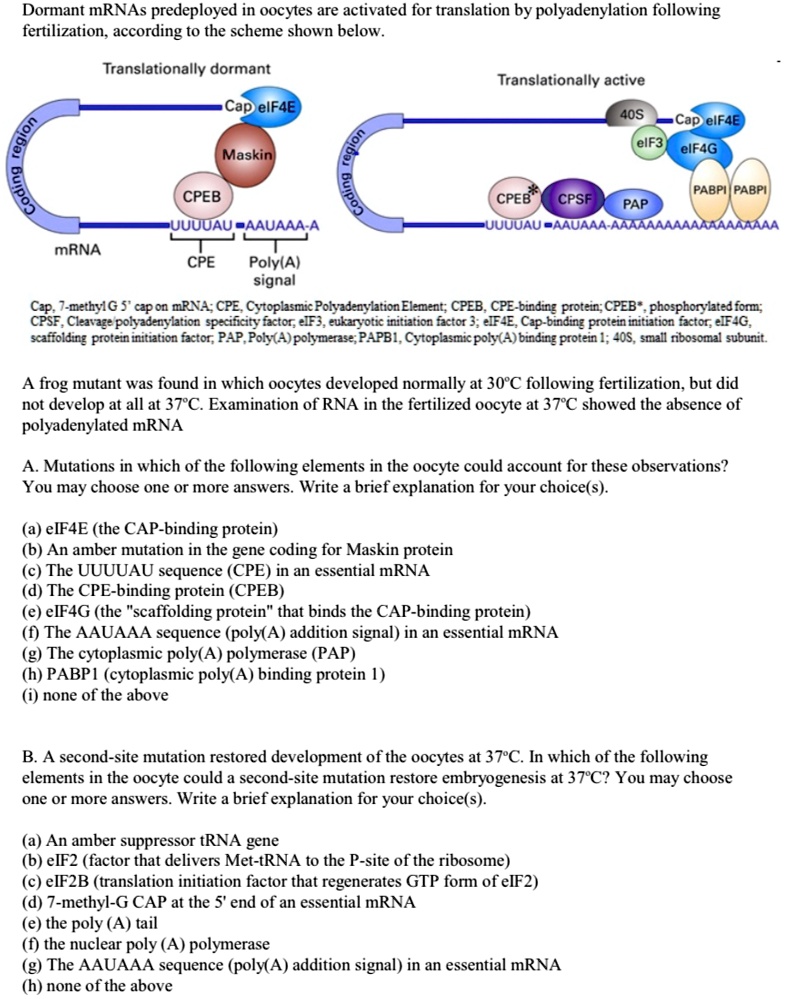
Dormant mRNAs predeployed in oocytes are activated for translation by polyadenylation following fertilization, according to the scheme shown below.
Translationally dormant
Cap elF4E
Maskin
Coding region
Translationally active
40S
Cap elF4E
elF3 elF4G
PABP1 PABP1
mRNA
UUUUAU AAUAAA-A
CPE Poly(A)
signal
UUUUAU AAUAAA-AAAAAAAAAAAAAAAAAAA
Cap, 7-methyl G 5' cap on mRNA; CPE, Cytoplasmic Polyadenylation Element; CPEB, CPE-binding protein; CPEB*, phosphorylated form;
CPSF, Cleavage/polyadenylation specificity factor, eIF3, eukaryotic initiation factor 3; eIF4E, Cap-binding protein initiation factor, eIF4G,
scaffolding protein initiation factor, PAP, Poly(A) polymerase; PAPB1, Cytoplasmic poly(A) binding protein 1; 40S, small ribosomal subunit.
A frog mutant was found in which oocytes developed normally at 30°C following fertilization, but did
not develop at all at 37°C. Examination of RNA in the fertilized oocyte at 37°C showed the absence of
polyadenylated mRNA
A. Mutations in which of the following elements in the oocyte could account for these observations?
You may choose one or more answers. Write a brief explanation for your choice(s).
(a) eIF4E (the CAP-binding protein)
(b) An amber mutation in the gene coding for Maskin protein
(c) The UUUUAU sequence (CPE) in an essential mRNA
(d) The CPE-binding protein (CPEB)
(e) eIF4G (the "scaffolding protein" that binds the CAP-binding protein)
(f) The AAUAAA sequence (poly(A) addition signal) in an essential mRNA
(g) The cytoplasmic poly(A) polymerase (PAP)
(h) PABP1 (cytoplasmic poly(A) binding protein 1)
(i) none of the above
B. A second-site mutation restored development of the oocytes at 37°C. In which of the following
elements in the oocyte could a second-site mutation restore embryogenesis at 37°C? You may choose
one or more answers. Write a brief explanation for your choice(s).
(a) An amber suppressor tRNA gene
(b) eIF2 (factor that delivers Met-tRNA to the P-site of the ribosome)
(c) eIF2B (translation initiation factor that regenerates GTP form of eIF2)
(d) 7-methyl-G CAP at the 5' end of an essential mRNA
(e) the poly (A) tail
(f) the nuclear poly (A) polymerase
(g) The AAUAAA sequence (poly(A) addition signal) in an essential mRNA
(h) none of the above