Ace - AI Tutor
Ask Our Educators
Textbooks
My Library
Flashcards
Scribe - AI Notes
Notes & Exams
Download App
adri-n richardson

adri-n r.

Divider

Questions asked

BEST MATCH

2-BP effect and Project effect are the only effects of trends in residential construction. True False

View Answer
divider
BEST MATCH

In a cell, proteins are made at structures called In a cell, proteins are made at structures called

View Answer
divider
BEST MATCH

In the context of mass media biases, what characterizes a media source that exhibits overt bias?

View Answer
divider
BEST MATCH

a chip with a dimension of 1 cm long and 8 mm wide stationed on an electronic board generates heat of about 0.06 w

View Answer
divider
BEST MATCH

Which term is also known as passive immunity? natural immunity immunity acquired immunity allergy

View Answer
divider
BEST MATCH

Let \(\mu\) be an eigenvalue of an invertible \(n \times n\) matrix \(A\). Show that \(\frac{1}{\mu}\) is an eigenvalue of \(A^{-1}\)

View Answer
divider
BEST MATCH

In Chapter 3, did you think about Glymph's claim that slaves were an essential feature of the plantation mistress's identity and the plantation family's status? What were some of the ways that worked in the plantation home? How did enslaved women resist the efforts to use them as a symbol for the plantation home?

View Answer
divider
BEST MATCH

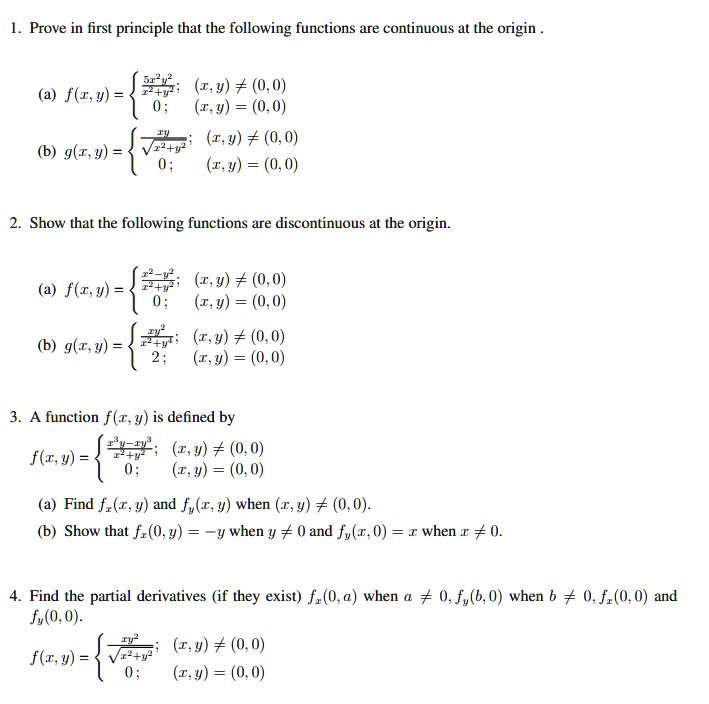
1. Prove in first principle that the following functions are continuous at the origin. (a) $f(x, y) = \begin{cases} \frac{5x^2y^2}{x^2+y^2} & (x, y) \neq (0,0) \\ 0; & (x, y) = (0,0) \end{cases}$ (b) $g(x, y) = \begin{cases} \frac{xy}{\sqrt{x^2+y^2}} & (x, y) \neq (0,0) \\ 0; & (x, y) = (0,0) \end{cases}$ 2. Show that the following functions are discontinuous at the origin. (a) $f(x, y) = \begin{cases} \frac{x^2-y^2}{x^2+y^2} & (x, y) \neq (0,0) \\ 0; & (x,y) = (0,0) \end{cases}$ (b) $g(x, y) = \begin{cases} \frac{xy^2}{x^2+y^4} & (x, y) \neq (0,0) \\ 2; & (x, y) = (0,0) \end{cases}$ 3. A function $f(x, y)$ is defined by $f(x, y) = \begin{cases} \frac{x^3-y^2}{x^2+y^2} & (x,y)\neq(0,0) \\ 0; & (x, y) = (0,0) \end{cases}$ (a) Find $f_x(x, y)$ and $f_y(x, y)$ when $(x, y) \neq (0,0)$. (b) Show that $f_x(0, y) = -y$ when $y \neq 0$ and $f_y(x, 0) = x$ when $x \neq 0$. 4. Find the partial derivatives (if they exist) $f_x(0, a)$ when $a \neq 0$, $f_y(b, 0)$ when $b \neq 0$, $f_x(0,0)$ and $f_y(0,0)$. $f(x, y) = \begin{cases} \frac{xy^2}{x^2+y^2} & (x, y) \neq (0,0) \\ 0; & (x, y) = (0,0) \end{cases}$
View Answer
divider
BEST MATCH

A change in a populations genes from one generation to the next due to chance, or accident is referred to as a

View Answer
divider
BEST MATCH

Find the derivative of each trigonometric function. f(x) = -4 sec x g(x) = 2 csc x f'(x) = g'(x) =

View Answer
divider