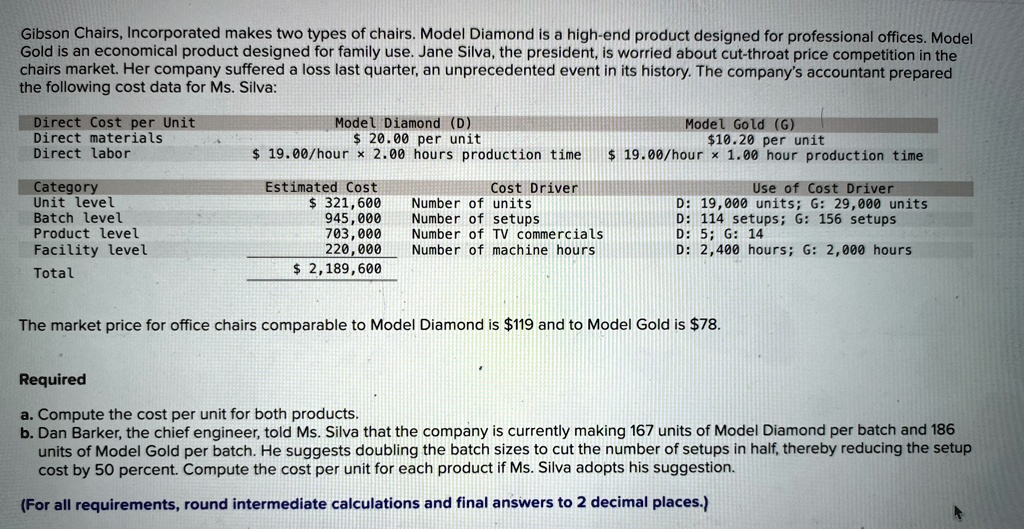
Gibson Chairs, Incorporated makes two types of chairs. Model Diamond is a high-end product designed for professional offices. Model Gold is an economical product designed for family use. Jane Silva, the president, is worried about cut-throat price competition in the chairs market. Her company suffered a loss last quarter, an unprecedented event in its history. The company's accountant prepared the following cost data for Ms. Silva:
Direct Cost per Unit
Direct materials
Direct labor
Category
Unit level
Batch level
Product level
Facility level
Total
Model Diamond (D)
\$ 20.00 per unit
\$ 19.00/hour x 2.00 hours production time
Estimated Cost
\$ 321,600
\$ 945,000
\$ 703,000
\$ 220,000
\$ 2,189,600
Cost Driver
Number of units
Number of setups
Number of TV commercials
Number of machine hours
Model Gold (G)
\$10.20 per unit
\$ 19.00/hour x 1.00 hour production time
Use of Cost Driver
D: 19,000 units; G: 29,000 units
D: 114 setups; G: 156 setups
D: 5; G: 14
D: 2,400 hours; G: 2,000 hours
The market price for office chairs comparable to Model Diamond is \$119 and to Model Gold is \$78.
Required
a. Compute the cost per unit for both products.
b. Dan Barker, the chief engineer, told Ms. Silva that the company is currently making 167 units of Model Diamond per batch and 186 units of Model Gold per batch. He suggests doubling the batch sizes to cut the number of setups in half, thereby reducing the setup cost by 50 percent. Compute the cost per unit for each product if Ms. Silva adopts his suggestion.
(For all requirements, round intermediate calculations and final answers to 2 decimal places.)