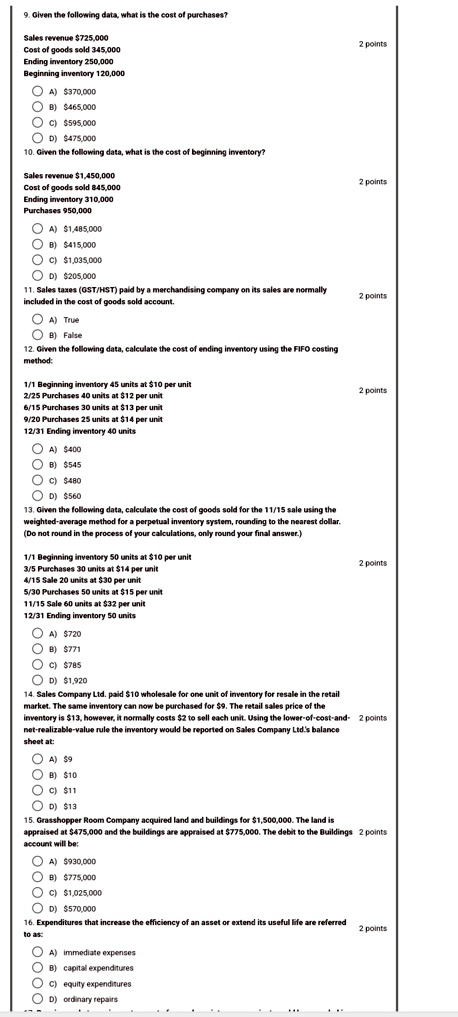
9. Given the following data, what is the cost of purchases?
Sales revenue $725,000
Cost of goods sold 345,000
Ending inventory 250,000
Beginning inventory 120,000
A) $370,000
B) $465,000
C) $595,000
D) $475,000
10. Given the following data, what is the cost of beginning inventory?
Sales revenue $1,450,000
Cost of goods sold 845,000
Ending inventory 310,000
Purchases 950,000
A) $1,485,000
B) $415,000
C) $1,035,000
D) $205,000
11. Sales taxes (GST/HST) paid by a merchandising company on its sales are normally
included in the cost of goods sold account.
A) True
B) False
12. Given the following data, calculate the cost of ending inventory using the FIFO costing
method:
1/1 Beginning inventory 45 units at $10 per unit
2/25 Purchases 40 units at $12 per unit
6/15 Purchases 30 units at $13 per unit
9/20 Purchases 25 units at $14 per unit
12/31 Ending inventory 40 units
A) $400
B) $545
C) $480
D) $560
13. Given the following data, calculate the cost of goods sold for the 11/15 sale using the
weighted-average method for a perpetual inventory system, rounding to the nearest dollar.
(Do not round in the process of your calculations, only round your final answer.)
1/1 Beginning inventory 50 units at $10 per unit
3/5 Purchases 30 units at $14 per unit
4/15 Sale 20 units at $30 per unit
5/30 Purchases 50 units at $15 per unit
11/15 Sale 60 units at $32 per unit
12/31 Ending inventory 50 units
A) $720
B) $771
C) $785
D) $1,920
14. Sales Company Ltd. paid $10 wholesale for one unit of inventory for resale in the retail
market. The same inventory can now be purchased for $9. The retail sales price of the
inventory is $13, however, it normally costs $2 to sell each unit. Using the lower-of-cost-and-
net-realizable-value rule the inventory would be reported on Sales Company Ltd.'s balance
sheet at:
A) $9
B) $10
C) $11
D) $13
15. Grasshopper Room Company acquired land and buildings for $1,500,000. The land is
appraised at $475,000 and the buildings are appraised at $775,000. The debit to the Buildings
account will be:
A) $930,000
B) $775,000
C) $1,025,000
D) $570,000
16. Expenditures that increase the efficiency of an asset or extend its useful life are referred
to as:
A) immediate expenses
B) capital expenditures
C) equity expenditures
D) ordinary repairs
2 points
2 points
2 points
2 points
2 points
2 points