A
B
C
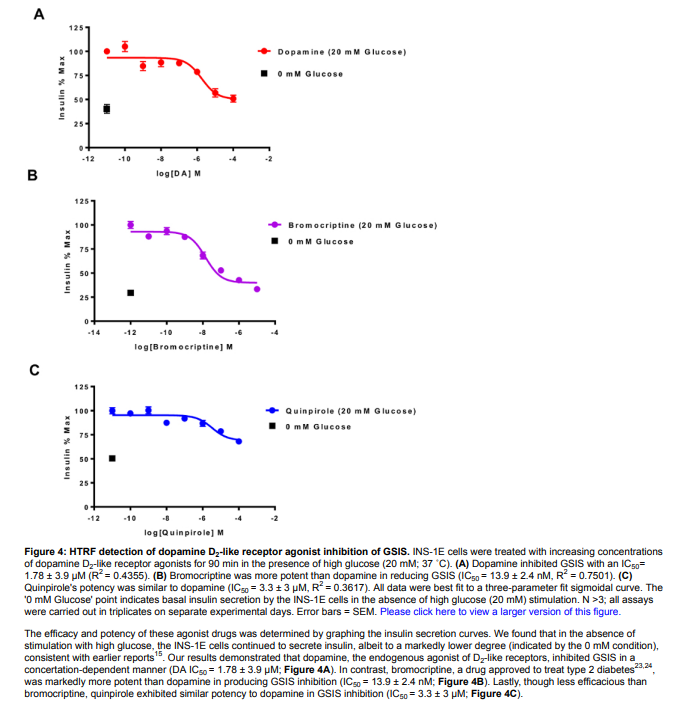
Figure 4: HTRF detection of dopamine \( D_{2} \)-like receptor agonist inhibition of GSIS. INS-1E cells were treated with increasing concentrations of dopamine \( \mathrm{D}_{2} \)-like receptor agonists for \( 90 \mathrm{~min} \) in the presence of high glucose \( \left(20 \mathrm{mM} ; 37{ }^{\circ} \mathrm{C}\right) \). (A) Dopamine inhibited GSIS with an IC \( { }_{50}= \) \( 1.78 \pm 3.9 \mu \mathrm{M}\left(\mathrm{R}^{2}=0.4355\right) \). (B) Bromocriptine was more potent than dopamine in reducing GSIS ( \( \mathrm{IC}_{50}=13.9 \pm 2.4 \mathrm{nM}, \mathrm{R}^{2}=0.7501 \) ). (C) Quinpirole's potency was similar to dopamine ( \( \left(\mathrm{C}_{50}=3.3 \pm 3 \mu \mathrm{M}, \mathrm{R}^{2}=0.3617\right. \) ). All data were best fit to a three-parameter fit sigmoidal curve. The ' \( 0 \mathrm{mM} \) Glucose' point indicates basal insulin secretion by the INS-1E cells in the absence of high glucose \( (20 \mathrm{mM}) \) stimulation. \( \mathrm{N}>3 \); all assays were carried out in triplicates on separate experimental days. Error bars = SEM. Please click here to view a larger version of this figure.
The efficacy and potency of these agonist drugs was determined by graphing the insulin secretion curves. We found that in the absence of stimulation with high glucose, the INS-1E cells continued to secrete insulin, albeit to a markedly lower degree (indicated by the \( 0 \mathrm{mM} \) condition), consistent with earlier reports \( { }^{15} \). Our results demonstrated that dopamine, the endogenous agonist of \( \mathrm{D}_{2} \)-like receptors, inhibited GSIS in a concertation-dependent manner (DA \( \mathrm{IC}_{50}=1.78 \pm 3.9 \mu \mathrm{M} \); Figure 4A). In contrast, bromocriptine, a drug approved to treat type 2 diabetes \( { }^{23,24} \), was markedly more potent than dopamine in producing GSIS inhibition ( \( \mathrm{IC}_{50}=13.9 \pm 2.4 \mathrm{nM} \); Figure \( 4 \mathrm{~B} \) ). Lastly, though less efficacious than bromocriptine, quinpirole exhibited similar potency to dopamine in GSIS inhibition (IC \( \mathrm{S}_{50}=3.3 \pm 3 \mu \mathrm{M} \); Figure \( 4 \mathrm{C} \) ).