Ace - AI Tutor
Ask Our Educators
Textbooks
My Library
Flashcards
Scribe - AI Notes
Notes & Exams
Download App
adriana hess

adriana h.

Divider

Questions asked

BEST MATCH

What is the ability of an individual to perform a job effectively? Agreeable Transparent Competence Objectivity

View Answer
divider
BEST MATCH

Question 100 The somatic motor division of the autonomic nervous system controls voluntary skeletal muscle. A True B False

View Answer
divider
BEST MATCH

QUESTION 39 Which of these statements describes the relationship between genetic drift and genetic variation? Genetic drift does not influence genetic variation. Genetic drift reduces genetic variation over the long term. Genetic drift only influences genetic variation if population sizes are small. Genetic drift increases genetic variation over the long term.

View Answer
divider
BEST MATCH

write a python program to add the two number by given user's

View Answer
divider
BEST MATCH

Solve the equation. \(2 + 2 \sin \theta = 4 \cos^2 \theta\) What is the solution in the interval \(0 \le \theta < 2\pi\)? Select the correct choice and fill in any answer boxes in your choice below. A. The solution set is (Simplify your answer. Type an exact answer, using \(\pi\) as needed. Type your answer in radians. Use integers or fractions for any numbers in the expression. Use a comma to separate answers as needed.) B. There is no solution.

View Answer
divider
BEST MATCH

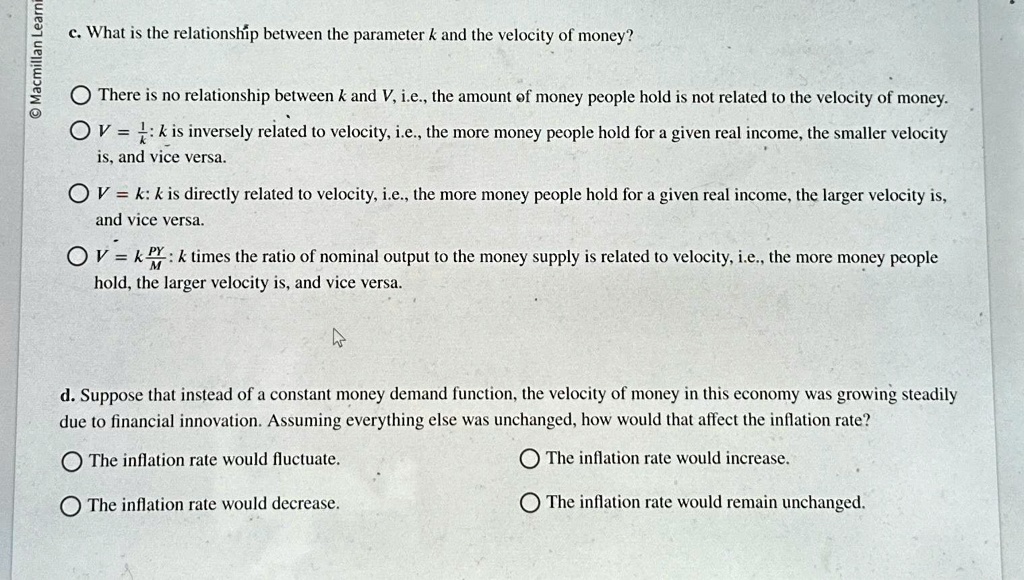
c. What is the relationship between the parameter \(k\) and the velocity of money? \(\circ\) There is no relationship between \(k\) and \(V\), i.e., the amount of money people hold is not related to the velocity of money. \(\circ\) \(V = \frac{1}{k}\): \(k\) is inversely related to velocity, i.e., the more money people hold for a given real income, the smaller velocity is, and vice versa. \(\circ\) \(V = k\): \(k\) is directly related to velocity, i.e., the more money people hold for a given real income, the larger velocity is, and vice versa. \(\circ\) \(V = k \frac{PY}{M}\): \(k\) times the ratio of nominal output to the money supply is related to velocity, i.e., the more money people hold, the larger velocity is, and vice versa. d. Suppose that instead of a constant money demand function, the velocity of money in this economy was growing steadily due to financial innovation. Assuming everything else was unchanged, how would that affect the inflation rate? \(\circ\) The inflation rate would fluctuate. \(\circ\) The inflation rate would decrease. \(\circ\) The inflation rate would increase. \(\circ\) The inflation rate would remain unchanged.
View Answer
divider
BEST MATCH

Suppose you are interested in studying the effect of education on salary. You propose the following regression of hourly wage on education: $\text{wage} = \beta_0 + \beta_1 \text{educ} + u$ where $\text{wage} = \text{hourly wage}$ $\text{educ} = \text{years of education}$ $u = \text{residual}$ Failing to account for industry, which may influence hourly wage and may be positively correlated with education, could lead to $\text{estimate of the effect } \beta_1$. This issue of confounding variables would likely bias the estimate of $\beta_1$

View Answer
divider
BEST MATCH

You are required to design an attack tree with a minimum of 2 subtargets and 2 subactions for each subtarget. Follow these three steps to construct the attack tree: 1. Identify the target or goal for an attack. 2. Identify the action to be taken to achieve the goal/target for that attack. 3. Identify subactions to identify subtargets. 4. You may find a mitigation plan for each subaction.

View Answer
divider
BEST MATCH

SOLUTIONS TO SELECTED END-OF-CH-27 PROBLEMS 1. The quantity of charge $q$ (in coulombs) that has passed through a surface of area 2.00 cm$^2$ varies with time according to the equation $q = 4t^3 + 5t + 6$, where $t$ is in seconds. (a) What is the instantaneous current through the surface at $t = 1.00$ s? (b) What is the value of the current density? Solution:

View Answer
divider
BEST MATCH

1. (a) Draw the unit cell of a Zinc blende lattice and show the (100) plane and [100] direction, (110) plane and [110] direction, (111) plane and [111] direction. (b) Determine the Miller indices for the planes shown in the diagrams below. [20 marks] [10 marks]

View Answer
divider