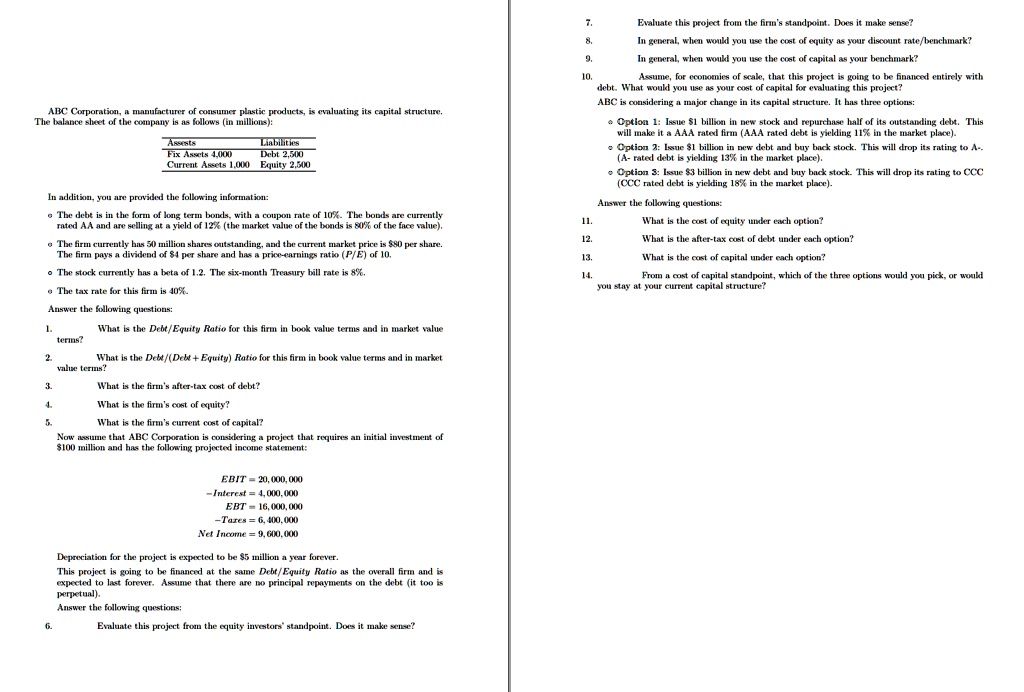
ABC Corporation, a manufacturer of consumer plastic products, is evaluating its capital structure.
The balance sheet of the company is as follows (in millions):
Assests
Fix Assets 4,000
Current Assets 1,000
Liabilities
Debt 2,500
Equity 2,500
In addition, you are provided the following information:
The debt is in the form of long term bonds, with a coupon rate of 10%. The bonds are currently rated AA and are selling at a yield of 12% (the market value of the bonds is 80% of the face value).
The firm currently has 50 million shares outstanding, and the current market price is $80 per share. The firm pays a dividend of $4 per share and has a price-earnings ratio ($P/E$) of 10.
The stock currently has a beta of 1.2. The six-month Treasury bill rate is 8%.
The tax rate for this firm is 40%.
Answer the following questions:
1. What is the Debt/Equity Ratio for this firm in book value terms and in market value terms?
2. What is the Debt/(Debt+Equity) Ratio for this firm in book value terms and in market value terms?
3. What is the firm's after-tax cost of debt?
4. What is the firm's cost of equity?
5. What is the firm's current of capital?
Now assume that ABC Corporation is considering a project that requires an initial investment of $100 million and has the following projected income statement:
$EBIT = 20,000,000$
$-Interest = 4,000,000$
$EBT = 16,000,000$
$-Taxes = 6,400,000$
$Net Income = 9,600,000$
Depreciation for the project is expected to be $5 million a year forever.
This project is going to be financed at the same Debt/Equity Ratio as the overall firm and is expected to last forever. Assume that there are no principal repayments on the debt (it too is perpetual).
Answer the following questions:
6. Evaluate this project from the equity investors' standpoint. Does it make sense?
7. Evaluate this project from the firm's standpoint. Does it make sense?
8. In general, when would you use the cost of equity as your discount rate/benchmark?
9. In general, when would you use the cost of capital as your benchmark?
10. Assume, for economies of scale, that this project is going to be financed entirely with debt. What would you use as your cost of capital for evaluating this project?
ABC is considering a major change in its capital structure. It has three options:
Option 1: Issue $1 billion in new stock and repurchase half of its outstanding debt. This will make it a AAA rated firm (AAA rated debt is yielding 11% in the market place).
Option 2: Issue $1 billion in new debt and buy back stock. This will drop its rating to A-. (A- rated debt is yielding 13% in the market place).
Option 3: Issue $3 billion in new debt and buy back stock. This will drop its rating to CCC (CCC rated debt is yielding 18% in the market place).
Answer the following questions:
11. What is the cost of equity under each option?
12. What is the after-tax cost of debt under each option?
13. What is the cost of capital under each option?
14. From a cost of capital standpoint, which of the three options would you pick, or would you stay at your current capital structure?