Charging and Discharging
Procedure
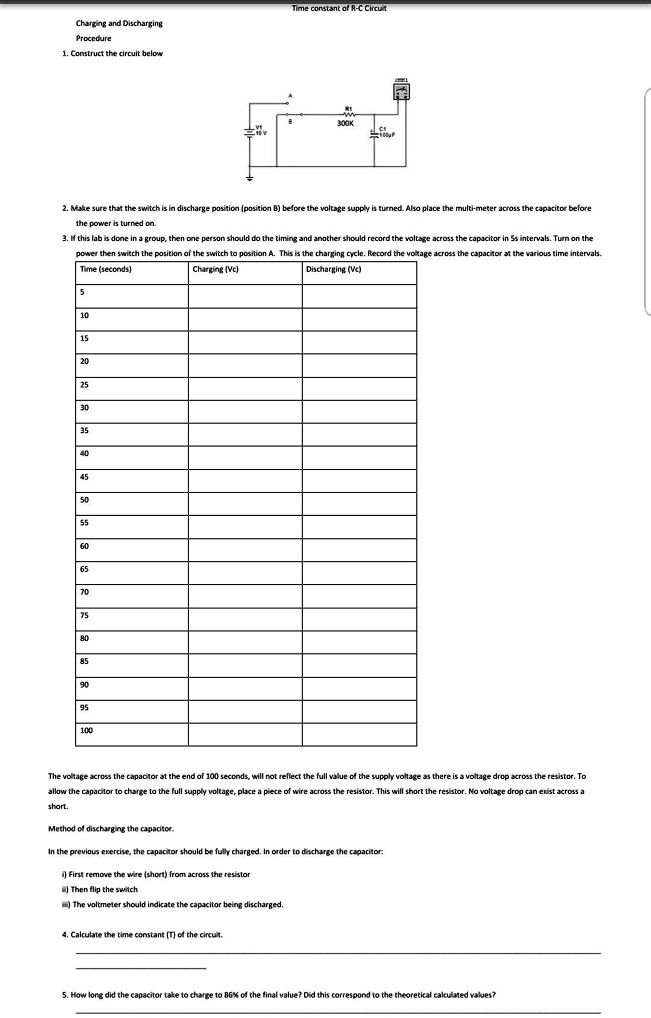
1. Construct the circuit below
Time constant of R-C Circuit
300K
2. Make sure that the switch is in discharge position (position B) before the voltage supply is turned. Also place the multi-meter across the capacitor before
the power is turned on.
3. If this lab is done in a group, then one person should do the timing and another should record the voltage across the capacitor in 5s intervals. Turn on the
power then switch the position of the switch to position A. This is the charging cycle. Record the voltage across the capacitor at the various time intervals.
Time (seconds)
Discharging (Vc)
Charging (Vc)
5
10
15
20
25
30
35
40
45
50
55
60
65
70
75
80
85
90
95
100
The voltage across the capacitor at the end of 100 seconds, will not reflect the full value of the supply voltage as there is a voltage drop across the resistor. To
allow the capacitor to charge to the full supply voltage, place a piece of wire across the resistor. This will short the resistor. No voltage drop can exist across a
short.
Method of discharging the capacitor.
In the previous exercise, the capacitor should be fully charged. In order to discharge the capacitor:
i) First remove the wire (short) from across the resistor
ii) Then flip the switch
iii) The voltmeter should indicate the capacitor being discharged.
4. Calculate the time constant ($\tau$) of the circuit.
5. How long did the capacitor take to charge to 86% of the final value? Did this correspond to the theoretical calculated values?