Chapter 8
Basic rules in the series circuits and the parallel circuit
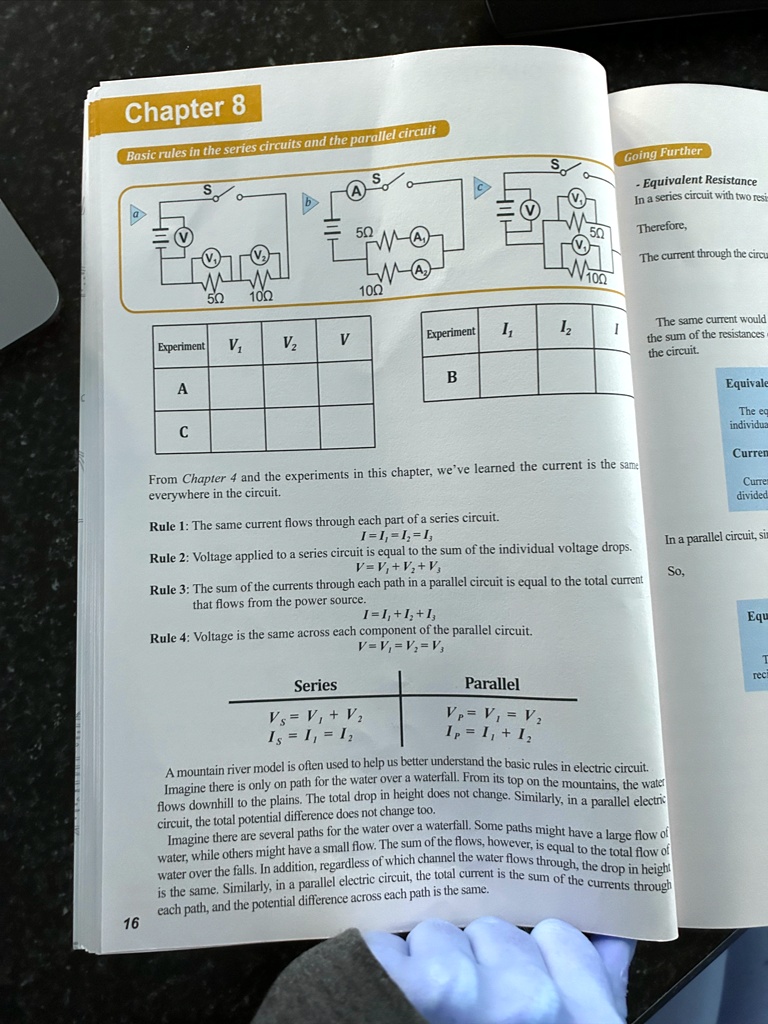
Experiment $V_1$ $V_2$ V
A
C
Experiment $I_1$ $I_2$ I
B
From Chapter 4 and the experiments in this chapter, we've learned the current is the same everywhere in the circuit.
Rule 1: The same current flows through each part of a series circuit.
$I = I_1 = I_2$
Rule 2: Voltage applied to a series circuit is equal to the sum of the individual voltage drops.
$V = V_1 + V_2 + V_3$
Rule 3: The sum of the currents through each path in a parallel circuit is equal to the total current that flows from the power source.
$I = I_1 + I_2 + I_3$
Rule 4: Voltage is the same across each component of the parallel circuit.
$V = V_1 = V_2 = V_3$
Series Parallel
$V_S = V_1 + V_2$ $V_P = V_1 = V_2$
$I_S = I_1 = I_2$ $I_P = I_1 + I_2$
A mountain river model is often used to help us better understand the basic rules in electric circuit. Imagine there is only on path for the water over a waterfall. From its top on the mountains, the water flows downhill to the plains. The total drop in height does not change. Similarly, in a parallel electric circuit, the total potential difference does not change too.
Imagine there are several paths for the water over a waterfall. Some paths might have a large flow of water, while others might have a small flow. The sum of the flows, however, is equal to the total flow of water over the falls. In addition, regardless of which channel the water flows through, the drop in height is the same. Similarly, in a parallel electric circuit, the total current is the sum of the currents through each path, and the potential difference across each path is the same.
Going Further
- Equivalent Resistance
In a series circuit with two resis
Therefore,
The current through the circuit
The same current would
the sum of the resistances
the circuit.
Equiv
The eq
individua
Curren
Curre
divided
In a parallel circuit, si
So,
Equ
Th
reci
16