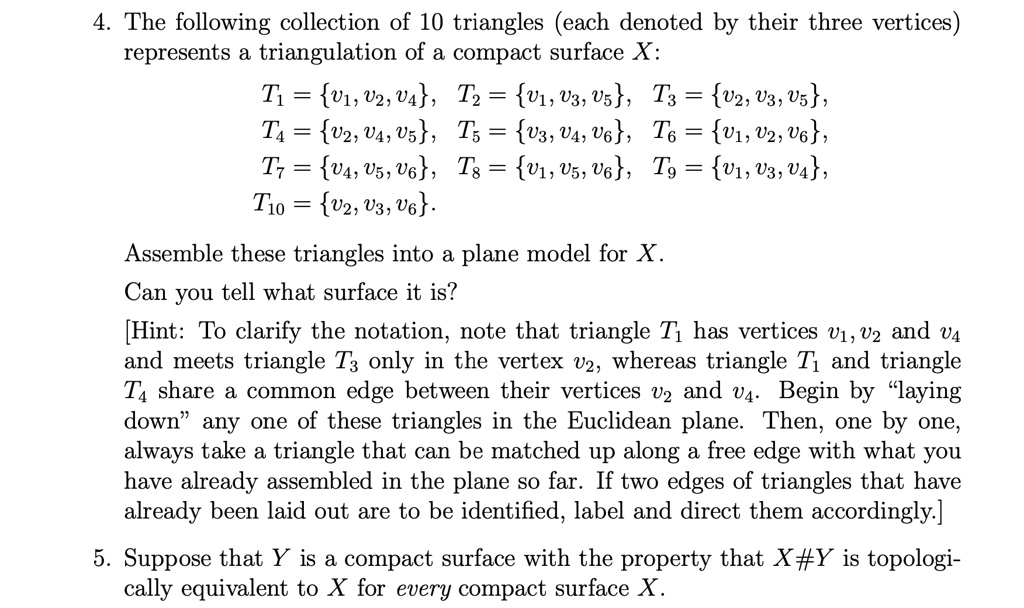
4. The following collection of 10 triangles (each denoted by their three vertices)
represents a triangulation of a compact surface X:
T? = {v?, v?, v?},
T? = {v?, v?, v?},
T? = {v?, v?, v?},
T? = {v?, v?, v?},
T? = {v?, v?, v?},
T? = {v?, v?, v?},
T? = {v?, v?, v?},
T? = {v?, v?, v?},
T? = {v?, v?, v?},
T?? = {v?, v?, v?}.
Assemble these triangles into a plane model for X.
Can you tell what surface it is?
[Hint: To clarify the notation, note that triangle T? has vertices v?, v? and v?
and meets triangle T? only in the vertex v?, whereas triangle T? and triangle
T? share a common edge between their vertices v? and v?. Begin by \"laying
down\" any one of these triangles in the Euclidean plane. Then, one by one,
always take a triangle that can be matched up along a free edge with what you
have already assembled in the plane so far. If two edges of triangles that have
already been laid out are to be identified, label and direct them accordingly.]
5. Suppose that Y is a compact surface with the property that X#Y is topologi-
cally equivalent to X for every compact surface X.