Ace - AI Tutor
Ask Our Educators
Textbooks
My Library
Flashcards
Scribe - AI Notes
Notes & Exams
Download App
agust-n planas

agust-n p.

Divider

Questions asked

BEST MATCH

Find the indefinite integral. (Remember the constant of integration.) sin4(3𝜃) d𝜃

View Answer
divider
BEST MATCH

The physical linking of a network to another networks essential facilities minders competition

View Answer
divider
BEST MATCH

1. Obtain the transfer function $X_2(S)/F(S)$ of the mechanical system shown in Figure. $K_1 = 4 N/m$ $x_1(t)$ $K_2 = 5 N/m$ $f_{v1} = 3 N-s/m$ $M_1 = 1 kg$ $f_{v2} = 3 N-s/m$ $M_2 = 2 kg$ $f_{v3} = 2 N-s/m$

View Answer
divider
BEST MATCH

Suppose the real money demand function is: Md/P = 3040 + 0.2Y - 10,000 (г +е). Assume M = 6000, P = 1.5, me = 0.01, and Y = 5000. The real interest rate that clears the asset market is a. 2%. • b. 3%. O c. 1%. • d. 4%.

View Answer
divider
BEST MATCH

Passive Transport: Movement of molecules from an area of higher concentration to an area of lower concentration is...

View Answer
divider
BEST MATCH

Seat Work \#1 Evaluate the following limits of a function using limit theorems: 1. \( \lim _{x \rightarrow-1} 2 x^{2}-4 x+10= \) ? \[ \text { 2. } \lim _{x \rightarrow 0}(2 x+3)(x+1)=\text { ? } \] n I \( \vdots \) \( \vdots \) \( \vdots \) 3. \( \lim _{x \rightarrow 5} \frac{2 x+5}{x^{2}+1}= \) ?

View Answer
divider
BEST MATCH

find the general solution to the differential equation y'''-y=x^2+2 Characteristic Equation: r^3-1=0

View Answer
divider
BEST MATCH

Problem 3: (10 points) Solve the following matrix equations using elimination matrices and/or permutation matrices. (a) $\begin{pmatrix} 1 & 5 & 6 \ 3 & 2 & 6 \ -1 & 9 & 7 \end{pmatrix} \vec{x} = \begin{pmatrix} 13 \ 14 \ 15 \end{pmatrix}$ (b) $\begin{pmatrix} 8 & -11 & 7 \ 6 & -10 & -5 \ 7 & -11 & -2 \end{pmatrix} \vec{x} = \begin{pmatrix} 16 \ 17 \ 18 \end{pmatrix}$

View Answer
divider
BEST MATCH

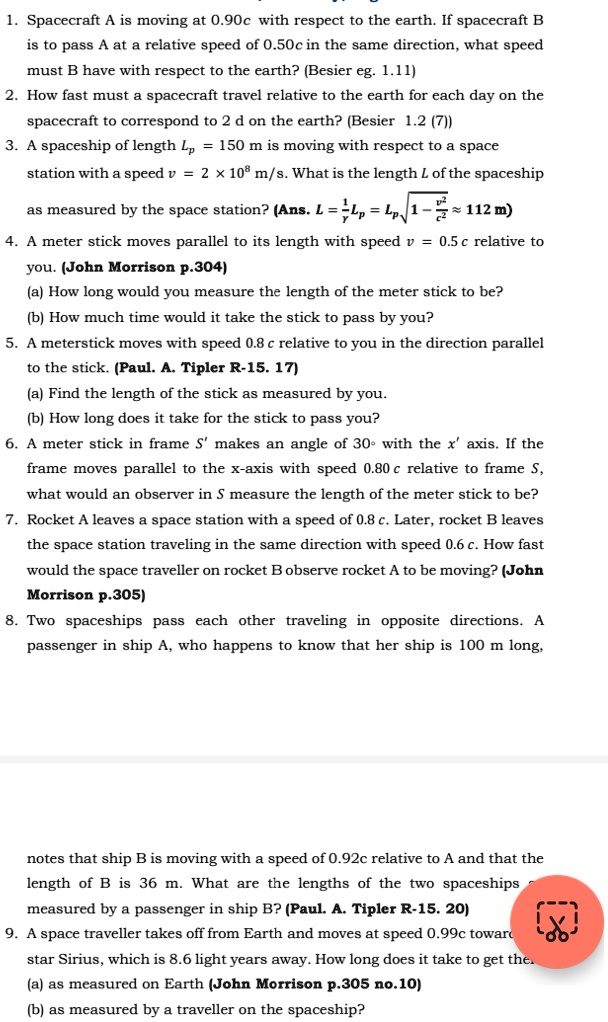
Texts: 1. Spacecraft A is moving at 0.90c with respect to the Earth. If spacecraft B is to pass A at a relative speed of 0.50c in the same direction, what speed must B have with respect to the Earth? (Answer: 0.40c) 2. How fast must a spacecraft travel relative to the Earth for each day on the spacecraft to correspond to 2 days on the Earth? (Answer: 1.5c) 3. A spaceship of length Lp = 150 m is moving with respect to a space station with a speed v = 2 * 10 m/s. What is the length L of the spaceship as measured by the space station? (Answer: L = Lp * √(1 - (v^2/c^2)) = 112 m) 4. A meter stick moves parallel to its length with speed v = 0.5c relative to you. (John Morrison p.304) (a) How long would you measure the length of the meter stick to be? (b) How much time would it take the stick to pass by you? 5. A meterstick moves with speed 0.8c relative to you in the direction parallel to the stick. (Paul.A. Tipler R-15. 17) (a) Find the length of the stick as measured by you. (b) How long does it take for the stick to pass you? 6. A meter stick in frame S' makes an angle of 30° with the x' axis. If the frame moves parallel to the x-axis with speed 0.80c relative to frame S, what would an observer in S measure the length of the meter stick to be? 7. Rocket A leaves a space station with a speed of 0.8c. Later, rocket B leaves the space station traveling in the same direction with speed 0.6c. How fast would the space traveler on rocket B observe rocket A to be moving? (John Morrison p.305) 8. Two spaceships pass each other traveling in opposite directions. A passenger in ship A, who happens to know that her ship is 100 m long, notes that ship B is moving with a speed of 0.92c relative to A and that the length of B is 36 m. What are the lengths of the two spaceships measured by a passenger in ship B? (Paul. A. Tipler R-15. 20) 9. A space traveler takes off from Earth and moves at a speed of 0.99c toward star Sirius, which is 8.6 light years away. How long does it take to get there? (a) As measured on Earth (John Morrison p.305 no.10) (b) As measured by a traveler on the spaceship?
View Answer
divider
BEST MATCH

Densities, as shown in the left-hand figure (the right-hand figure shows the electric field lines). Problem 2.20: The charge density in two dimensions can be expressed as ρ = ρ0 - 1/a^8 - n/2 a) Using the Green function expansion from Problem 2.17c, show that the electrostatic potential is Φ = cos[(4k+2)] b) Relate the solution of part a to the real part of the complex function 2z - iaz + i where z = x + iy = pe. Comment on the connection to Problem 2.3. c) Find expressions for the Cartesian components of the electric field near the origin, expressed in terms of x and y. Keep the k=0 and k=1 terms in the expansion. For y=0, what is the relative magnitude of the k=12-pole monopole contribution to E, compared to the k=022-pole or quadrupole term?

View Answer
divider