Example 2: ((x)/(t_(1)))/(t_(2))=((x)/(t_(1)))/((t_(2))/(1))=(x)/(t_(1))*(1)/(t_(2))=(x)/(t_(1)t_(2))
Adding or subtracting two fractions:
Multiply each fraction by a factor that equals 1 so that
they have the same denominator (i.e., find a common
denominator). A simple and general way to do this is to
multiply the first fraction by a fraction that has the
denominator of the second fraction in both its numerator
and denominator, and multiply the second fraction by a
fraction that has the denominator of the first fraction in
both its numerator and denominator.
The numerator of the resulting fraction is the sum or
difference of the numerators of the two fractions; the
denominator of the resulting fraction is just the common
denominator.
Example:
(2d)/(3)-(2d)/(5)=((5)/(5)*(2d)/(3))-((3)/(3)*(2d)/(5))=(10d)/(15)-(6d)/(15)=(10d-6d)/(15)=
Part A - Finding acceleration (I)
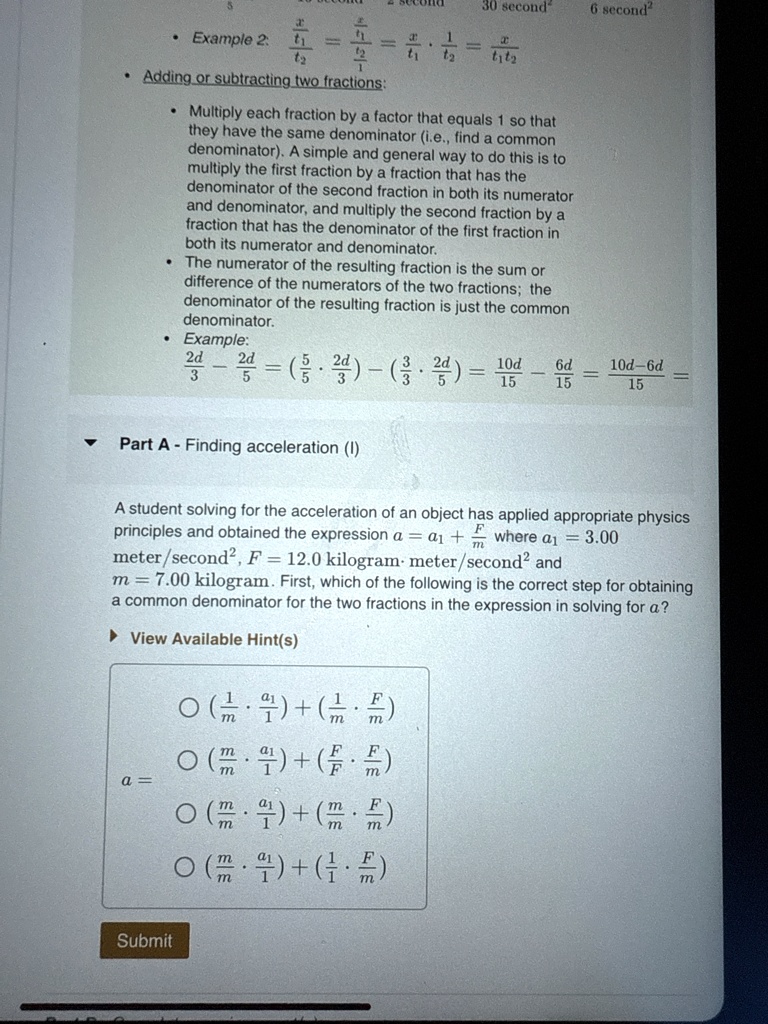
A student solving for the acceleration of an object has applied appropriate physics
principles and obtained the expression a=a_(1)+(F)/(m) where a_(1)=3.00
mete(r)/(second )^(2),F=12.0 kilogram * meter ()/() second ^(2) and
m=7.00 kilogram. First, which of the following is the correct step for obtaining
a common denominator for the two fractions in the expression in solving for a ?
View Available Hint(s)
a={(:[((1)/(m)*(a_(1))/(1))+((1)/(m)*(F)/(m))]),(((m)/(m)*(a_(1))/(1))+((F)/(F)*(F)/(m))),(((m)/(m)*(a_(1))/(1))+((m)/(m)*(F)/(m))),(((m)/(m)*(a_(1))/(1))+((1)/(1)*(F)/(m))):}