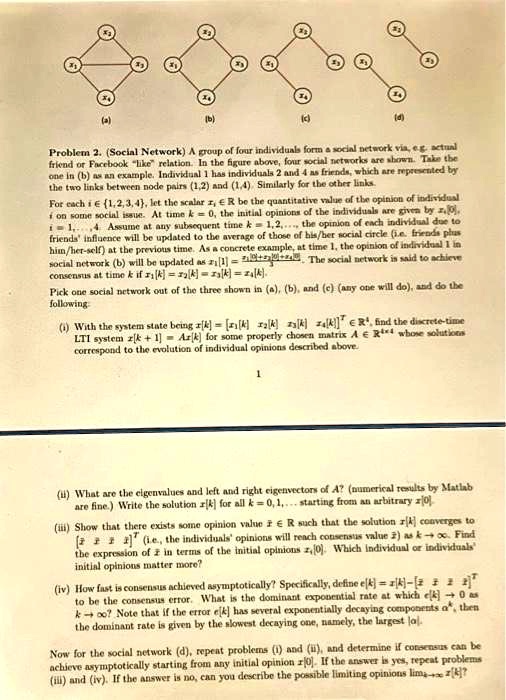
Texts: (a) (b) X4 (c) (d)
Problem 2. (Social Network)
A group of four individuals form a social network via, e.g. actual friend or Facebook "like" relation. In the figure above, four social networks are shown. Take the one in (b) as an example. Individual 1 has individuals 2 and 4 as friends, which are represented by the two links between node pairs (1,2) and (1,4). Similarly for the other links.
For each i ∈ {1,2,3,4}, let the scalar zᵢ ∈ ℝ be the quantitative value of the opinion of individual i on some social issue. At time k = 0, the initial opinions of the individuals are given by z[0], i = 1,...,4. Assume at any subsequent time k = 1,2,..., the opinion of each individual due to friends' influence will be updated to the average of those of his/her social circle (i.e. friends plus him/her-self) at the previous time. As a concrete example, at time 1, the opinion of individual 1 in social network (b) will be updated as z₁[1] = (0+20+40)/3.
The social network is said to achieve consensus at time k if z₁[k] = z₂[k] = z₃[k] = z₄[k].
1. Pick one social network out of the three shown in (a), (b), and (c) (any one will do), and do the following:
(i) With the system state being z[k] = [z₁[k] z₂[k] z₃[k] z₄[k]] ∈ ℝ¹, find the discrete-time LTI system z[k+1] = Az[k] for some properly chosen matrix A ∈ ℝ⁴ˣ⁴ whose solutions correspond to the evolution of individual opinions described above.
(ii) What are the eigenvalues and left and right eigenvectors of A? (numerical results by Matlab are fine.) Write the solution z[k] for all k = 0, 1,... starting from an arbitrary z[0].
(iii) Show that there exists some opinion value zᵢ ∈ ℝ such that the solution z[k] converges to [zᵢ zᵢ zᵢ zᵢ] (i.e., the individuals' opinions will reach consensus value zᵢ) as k → ∞. Find the expression of zᵢ in terms of the initial opinions z[0]. Which individual or individuals' initial opinions matter more?
(iv) How fast is consensus achieved asymptotically? Specifically, define e[k] = z[k] - [zᵢ zᵢ zᵢ zᵢ] to be the consensus error. What is the dominant exponential rate at which e[k] → 0 as k → ∞? Note that if the error e[k] has several exponentially decaying components, then the dominant rate is given by the slowest decaying one, namely, the largest eigenvalue.
Now for the social network (d), repeat problems (i) and (ii), and determine if consensus can be achieved asymptotically starting from any initial opinion z[0]. If the answer is yes, repeat problems (iii) and (iv). If the answer is no, can you describe the possible limiting opinions lim → ∞ z[k]?