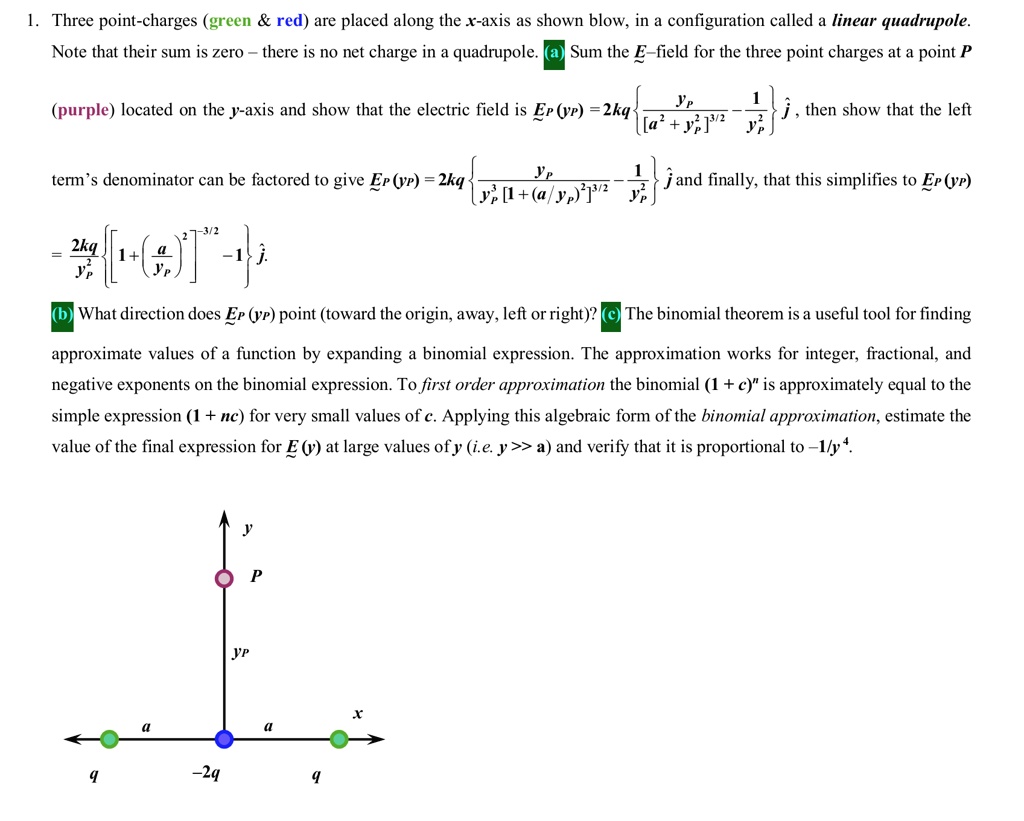
1. Three point-charges (green & red) are placed along the x-axis as shown blow, in a configuration called a linear quadrupole. Note that their sum is zero – there is no net charge in a quadrupole. (a) Sum the $E$-field for the three point charges at a point $P$ (purple) located on the y-axis and show that the electric field is $E_P(y_P) = 2kq \left[ \frac{y_P}{(a^2 + y_P^2)^{3/2}} - \frac{1}{y_P^2} \right] \hat{j}$, then show that the left term’s denominator can be factored to give $E_P(y_P) = 2kq \left[ \frac{y_P}{y_P^3 (1 + (a/y_P)^2)^{3/2}} - \frac{1}{y_P^2} \right] \hat{j}$ and finally, that this simplifies to $E_P(y_P) = \frac{2kq}{y_P^2} \left[ \left[ 1 + \left( \frac{a}{y_P} \right)^2 \right]^{-3/2} - 1 \right] \hat{j}$. (b) What direction does $E_P(y_P)$ point (toward the origin, away, left or right)? (c) The binomial theorem is a useful tool for finding approximate values of a function by expanding a binomial expression. The approximation works for integer, fractional, and negative exponents on the binomial expression. To first order approximation the binomial $(1 + c)^n$ is approximately equal to the simple expression $(1 + nc)$ for very small values of $c$. Applying this algebraic form of the binomial approximation, estimate the value of the final expression for $E(y)$ at large values of $y$ (i.e. $y \gg a$) and verify that it is proportional to $-1/y^4$.