Ace - AI Tutor
Ask Our Educators
Textbooks
My Library
Flashcards
Scribe - AI Notes
Notes & Exams
Download App
Ahmed Al Badi

Ahmed A.

Divider

Questions asked

ANSWERED

Eduard Sanchez verified

Numerade educator

What is the drift velocity of an electron in a copper wire of radius r =900mm and A uniform current i= 17 mA ?

View Answer
divider
ANSWERED

Prabhu Ramji verified

Numerade educator

Show that ( V_{o} ) in the circuit is ( 2 mathrm{~V} ).

View Answer
divider
ANSWERED

Supratim Pal verified

Numerade educator

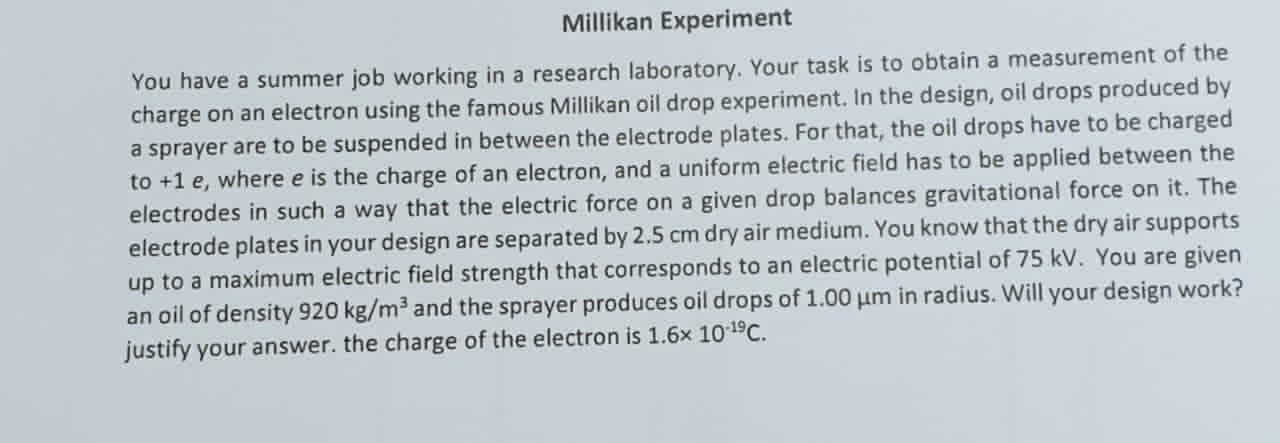
Millikan Experiment You have a summer job working in a research laboratory. Your task is to obtain a measurement of the charge on an electron using the famous Millikan oil drop experiment. In the design, oil drops produced by a sprayer are to be suspended in between the electrode plates. For that, the oil drops have to be charged to +1 e, where e is the charge of an electron, and a uniform electric field has to be applied between the electrodes in such a way that the electric force on a given drop balances gravitational force on it. The electrode plates in your design are separated by 2.5 cm dry air medium. You know that the dry air supports up to a maximum electric field strength that corresponds to an electric potential of 75 kV. You are given an oil of density 920 kg/m³ and the sprayer produces oil drops of 1.00 ?m in radius. Will your design work? justify your answer. the charge of the electron is 1.6× 10?¹?C.
View Answer
divider
ANSWERED

Prabhu Ramji verified

Numerade educator

Choose the INCORRECT statement: Gauss' law applies to a closed surface of any shape Gauss' law can be derived from Coulomb's law Gauss' law states that the net number of lines crossing any closed surface in an outward direction is proportional to the net charge enclosed within the surface Coulomb's law can be derived from Gauss' law and symmetry According to Gauss' law, if a closed surface encloses no charge, then the electric Field must vanish everywhere on the surface

View Answer
divider
ANSWERED

Prabhu Ramji verified

Numerade educator

A point particle with charge q is placed inside a cube but not at its center. The electric flux through any one side of the cube: is q/4??0 is zero Cannot be computed using Gauss' law is q/??0 is q/6??0

View Answer
divider
ANSWERED

You are working in cooperation with the Ministry of Environmental Affairs to design an electrostatic trap for particles from auto emissions. The average particle, whose mass is \( 6.0 \times 10^{-9} \) \( \mathrm{kg} \), enters the device and is exposed to ultraviolet radiation that knocks off electrons so that it has a charge of \( +3.0 \times 10^{-8} \) C. This average particle then moves at a speed of \( 900.0 \mathrm{~m} / \mathrm{s} \) and is \( 15 \mathrm{~cm} \) from a very long negatively charged wire with a linear charge density of \( \left(-8.0 \times 10^{-6} \mathrm{C} / \mathrm{m}\right) . \) The wire is perpendicular to the direction of motion of the particle. The detector for the particle is located \( 7.0 \mathrm{~cm} \) in front of the wire. The detector can withstand particles with a maximum speed of \( 1200 \mathrm{~m} / \mathrm{s} \). Is your design feasible?

View Answer
divider