Ace - AI Tutor
Ask Our Educators
Textbooks
My Library
Flashcards
Scribe - AI Notes
Notes & Exams
Download App
ahsan n

ahsan n.

Divider

Questions asked

INSTANT ANSWER

Consider the power series \[ \text { (i) } \sum \frac{n !}{n^{n}} x^{n} \quad \text { and } \quad \text { (ii) } \sum \frac{n^{n}}{n !} x^{n} . \] a) Show that their radii of convergence are \( e \) and \( e^{-1} \) respectively. b) Show, by any method, that \( a(n)=\left(1+\frac{1}{n}\right)^{n} \) is a strictly increasing sequence (whose limit is \( e \) ). c) Deduce from your working in (a) and (b) that (i) diverges when \( x=\pm e \). d) Here you may assume Stirling's formula: \[ n ! /\left\{\sqrt{2 \pi} n^{n+1 / 2} e^{-n}\right\} \rightarrow 1 \quad \text { as } n \rightarrow \infty \] Show that series (ii) diverges when \( x=e^{-1} \). Using Stirling's formula and (b), show that (ii) is conditionally convergent when \( x=-e^{-1} \).

View Answer
divider
INSTANT ANSWER

Suppose that \[ f(x)=\left\{\begin{array}{ll} e^{-1 / x^{2}} & \text { if } x \neq 0 \\ 0 & \text { if } x=0 \end{array}\right. \] a) Show that \( f \) is differentiable everywhere and find a formula for \( f^{\prime} \). b) Show that \( f^{\prime} \) is differentiable everywhere and find a formula for \( f^{\prime \prime} \). c) Suppose that \( k \) is a positive integer. Prove that \( \frac{d}{d x}\left(\frac{e^{-1 / x^{2}}}{x^{k}}\right) \) is a linear combination of functions of the form \( \frac{e^{-1 / x^{2}}}{x^{m}} \), where \( m \) is a positive integer. d) Hence deduce that \( f^{(n)}(0)=0 \) for every natural number \( n \). e) Write down the Maclaurin series for \( f \). Where does the Maclaurin series converge? Where does it converge to \( f ? \)

View Answer
divider
INSTANT ANSWER

e) \( \sum_{k=2}^{\infty} \frac{(-1)^{k+1} k^{2}}{\sqrt{4 k^{4}+1}} \) f) \( \sum_{k=1}^{\infty} \frac{\sin ((2 k-1) \pi / 4)}{2^{k}} \)

View Answer
divider
INSTANT ANSWER

Consider the alternating series \( \sum_{k=0}^{\infty} \frac{(-1)^{k}}{k^{3}+1} . \) Let \( L \) denote the value of the series and let \( s_{n} \) denote the \( n \) th partial sum of the series whenever \( n \geq 0 \). a) Verify that the series is convergent. b) Calculate \( s_{4} \) and give an upper bound for the absolute error in the approximation \( L \approx s_{4} . \) c) Find a value for \( n \) such that the absolute error in the approximation \( L \approx s_{n} \) is less than \( 10^{-6} \).

View Answer
divider
INSTANT ANSWER

d) \( \sum_{k=1}^{\infty} \frac{5^{k}}{2^{k}+4^{k}} \)

View Answer
divider
INSTANT ANSWER

f) \( \sum_{k=1}^{\infty} \sin ^{2} \frac{1}{k} \)

View Answer
divider
INSTANT ANSWER

Let \( s_{n} \) denote the \( n \) th partial sum of the harmonic series series \( \sum_{k=1}^{\infty} \frac{1}{k} \). When \( n=2^{k-1} \), the terms of \( s_{n} \) may be bracketed as shown: \( s_{n}=1+\frac{1}{2}+\left(\frac{1}{3}+\frac{1}{4}\right)+\left(\frac{1}{5}+\ldots+\frac{1}{8}\right)+\cdots+\left(\frac{1}{2^{k-2}+1}+\frac{1}{2^{k-2}+2}+\ldots+\frac{1}{2^{k-1}}\right) \) Hence use an argument to show that the harmonic series diverges.

View Answer
divider
ANSWERED

Ian Grigsby verified

Numerade educator

Let ( s_{n} ) denote the ( n ) th partial sum of the series [ 1+frac{1}{sqrt{2}}+frac{1}{sqrt{3}}+cdots ] a) Show that ( s_{n}>sqrt{n} ) whenever ( n>1 ). b) Hence explain why the series diverges.

View Answer
divider
ANSWERED

Oswaldo Jiménez verified

Numerade educator

The limit of a recursively defined sequence. Suppose that ( a_{1}=1 ) and ( a_{n+1}=sqrt{1+a_{n}} ) whenever ( n geq 1 ) a) Show that ( sqrt{1+x} in[1,2] ) whenever ( x in[1,2] ). b) Use induction to show that the sequence ( left{a_{n} ight} ) is bounded. c) Use induction to show that ( left{a_{n} ight} ) is an increasing sequence. d) Explain why ( lim _{n ightarrow infty} a_{n} ) exists. e) Find ( lim _{n ightarrow infty} a_{n} ). (That is, find ( sqrt{1+sqrt{1+sqrt{1+cdots}}} ).)

View Answer
divider
ANSWERED

Leon Druch verified

Numerade educator

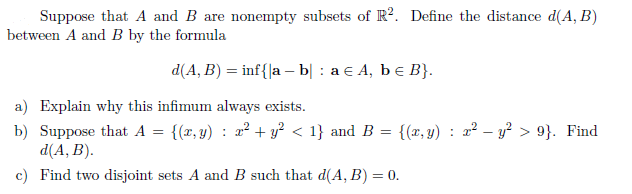
Suppose that ( A ) and ( B ) are nonempty subsets of ( mathbb{R}^{2} ). Define the distance ( d(A, B) ) between ( A ) and ( B ) by the formula [ d(A, B)=inf {|mathbf{a}-mathbf{b}|: mathbf{a} in A, mathbf{b} in B} ] a) Explain why this infimum always exists. b) Suppose that ( A=left{(x, y): x^{2}+y^{2}<1 ight} ) and ( B=left{(x, y): x^{2}-y^{2}>9 ight} ). Find ( d(A, B) ) c) Find two disjoint sets ( A ) and ( B ) such that ( d(A, B)=0 ).
View Answer
divider