Texts:
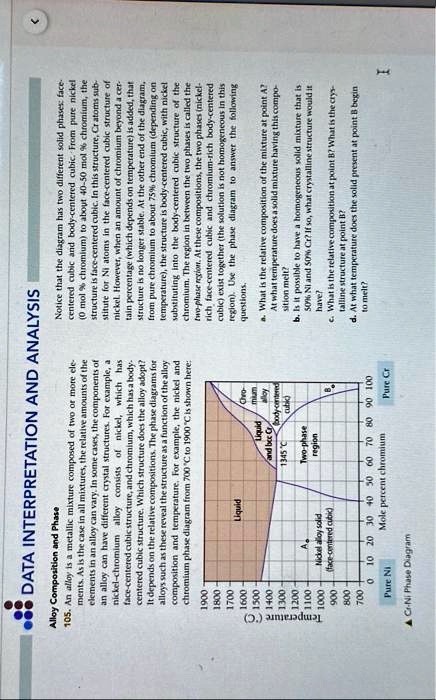
Notice that the diagram has two different solid phases - face-centered cubic and body-centered cubic. From pure nickel, the structure is face-centered cubic. In this structure, Cr atoms substitute for Ni atoms in the face-centered cubic structure, and the structure is no longer stable. At the other end of the diagram, from pure chromium to about 75% chromium (depending on temperature), the structure is body-centered cubic, with nickel substituting into the body-centered cubic structure of the chromium. The region in between the two phases is called the two-phase region. At these compositions, the two phases (nickel-rich face-centered cubic and chromium-rich body-centered cubic) coexist.
What is the relative composition of the mixture at point A?
Is it possible to have a homogeneous solid mixture that is crystalline in structure at point B?
At what temperature does the solid present at point B begin?
DATA INTERPRETATION AND ANALYSIS ONC Apnbn hoge 105.
An alloy is a metallic mixture composed of two or more elements. As is the case in all mixtures, the relative amounts of the elements in an alloy can vary. In some cases, the components form a face-centered cubic structure, and in other cases, they form a body-centered cubic structure. It depends on the relative compositions.
The phase diagrams for a 6 Ni alloy are shown below:
Mole percent chromium:
1900: 0.081
100: 1.500
1500: 1.100
face-centered cubic: 1.600 (O.)
10: 0.080
0: 0.060
0: 0.080
0: 0.00
Ni and Cr-Ni Phase Diagram