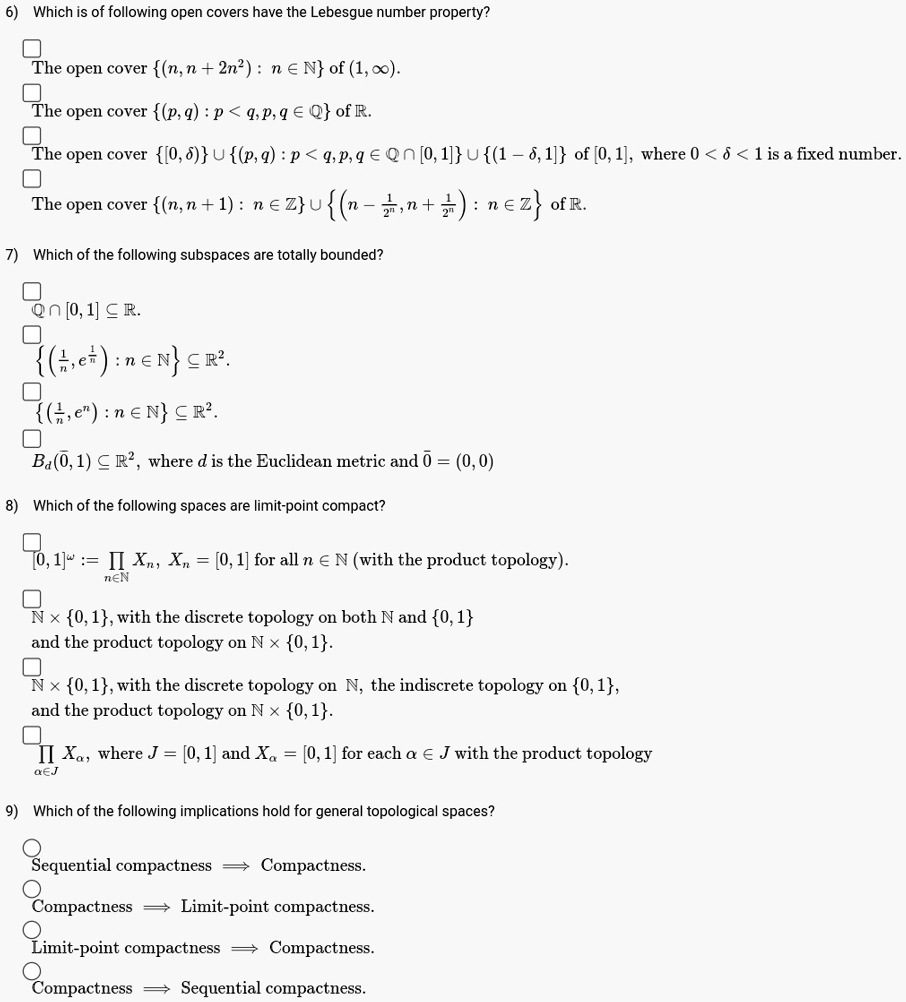
Which of the following open covers have the Lebesgue number property?
1. The open cover {(n, n+2n): n in N} of (1, ∞).
2. The open cover R0,10<δ<1{(n, n+1): n in Z} U {(n-(1)/(2^(n)), n+(1)/(2^(n)): n in Z} ∩ [0,1] subset of R{((1)/(n), e^((1)/(n))): n in N} subset of R^(2).
3. {((1)/(n), e^(n)): n in N} subset of R^(2).
4. B_d(/bar(0),1) subset of R^(2) d/bar(0)=(0,0)[J,1]^(ω):=prod_(n in N)x_(n), x_(n)=[0,1] n in NN x {0,1}N{0,1}N x {0,1}N x {0,1}N{0,1}N x {0,1}prod_(α in J)x_(α) J=[0,1]x_(α)=[0,1]α in J
Which of the following open covers have the Lebesgue number property?
1. The open cover {n, n+2n: n in N} of 1,0.
2. The open cover {(p, q) : p< q, p, q in Q} of R.
3. The open cover {[0,&)} U {p,q): p<q, p,q in Q[0,1]} U {(1-&,1]} of [0,1], where 0<<1 is a fixed number.
4. The open cover {(n, n+1): n in Z} U {(n-h, n+): n in Z} of R
Which of the following subspaces are totally bounded?
1. Q ∩ [0,1] subset of R.
2. {4, e): n in N} subset of R^2
3. {(h, e): n in N} subset of R^2.
4. B_ε(0,1) subset of R^2, where d is the Euclidean metric and 0= (0, 0)
Which of the following spaces are limit-point compact?
1. [0,1]" := Π Xn, Xn = [0,1] for all n in N (with the product topology) n in N
2. N ∪ {0,1}, with the discrete topology on both N and {0,1} and the product topology on N ∪ {0,1}
3. N ∪ {0, 1}, with the discrete topology on N, the indiscrete topology on {0, 1}, and the product topology on N ∪ {0, 1}.
4. Π Xα, where J = [0,1] and Xα = [0, 1] for each α in J with the product topology α in J
Which of the following implications hold for general topological spaces?
1. Sequential compactness = Compactness.
2. Compactness = Limit-point compactness.
3. Limit-point compactness = Compactness.
4. Compactness = Sequential compactness.