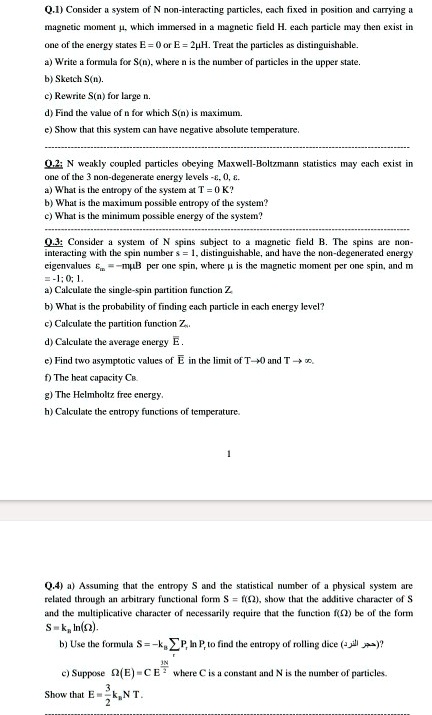
Q.1 Consider a system of N non-interacting particles, each fixed in position and carrying a magnetic moment, which are immersed in a magnetic field H. Each particle may then exist in one of the energy states E = 0 or E = 2H. Treat the particles as distinguishable.
a) Write a formula for S(n), where n is the number of particles in the upper state.
b) Sketch S(n).
c) Rewrite S(n) for large n.
d) Find the value of n for which S(n) is maximum.
e) Show that this system can have negative absolute temperature.
Q.2: N weakly coupled particles obeying Maxwell-Boltzmann statistics may each exist in one of the 3 non-degenerate energy levels -E, 0, or E.
a) What is the entropy of the system at T = 0 K?
b) What is the maximum possible entropy of the system?
c) What is the minimum possible energy of the system?
Q.3: Consider a system of N spins subject to a magnetic field B. The spins are non-interacting with the spin number s = 1, distinguishable, and have the non-degenerate energy eigenvalues E = -mB per one spin, where E is the magnetic moment per one spin, and m = -1, 0, or 1.
a) Calculate the single-spin partition function Z.
b) What is the probability of finding each particle in each energy level?
c) Calculate the partition function Z.
d) Calculate the average energy E.
e) Find two asymptotic values of E in the limit of T approaching 0 and T approaching infinity.
f) Calculate the heat capacity C.
g) Calculate the Helmholtz free energy.
h) Calculate the entropy as a function of temperature.
Q.4 a) Assuming that the entropy S and the statistical number of a physical system are related through an arbitrary functional form S = f(E), show that the additive character of S and the multiplicative character of E necessarily require that the function f(E) be of the form S = k ln(E).
b) Use the formula S = k ln(P) to find the entropy of rolling dice (N sides).
c) Suppose E = C/N, where C is a constant and N is the number of particles. Show that E = kNT.