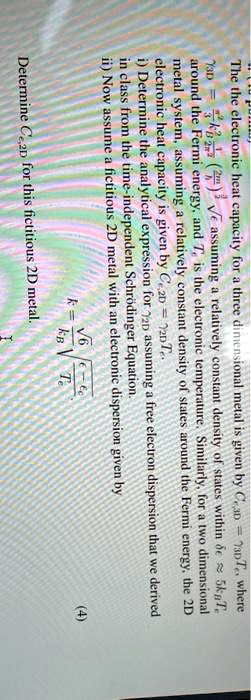
The the electronic heat capacity for a three dimensional metal is given by $C_{2D} = \gamma_{2D} T$, where \begin{equation*} \gamma_{2D} = \frac{\pi^2 k_B^2}{2} \left( \frac{\partial n}{\partial \epsilon} \right)_{\epsilon = \epsilon_F} \end{equation*} assuming a relatively constant density of states within $\delta \epsilon \approx 5k_B T_e$ around the Fermi energy, and $T_e$ is the electronic temperature. Similarly, for a two dimensional metal system, assuming a relatively constant density of states around the Fermi energy, the 2D electronic heat capacity is given by $C_{e2D} = \gamma_{2D} T_e$
i) Determine the analytical expression for $\gamma_{2D}$ assuming a free electron dispersion that we derived in class from the time-independent Schrödinger Equation.
ii) Now assume a fictitious 2D metal with an electronic dispersion given by
$k = \sqrt{\frac{6}{\epsilon - \epsilon_c}} \sqrt{\frac{\epsilon - \epsilon_c}{T_e}}$
Determine $C_{e2D}$ for this fictitious 2D metal.