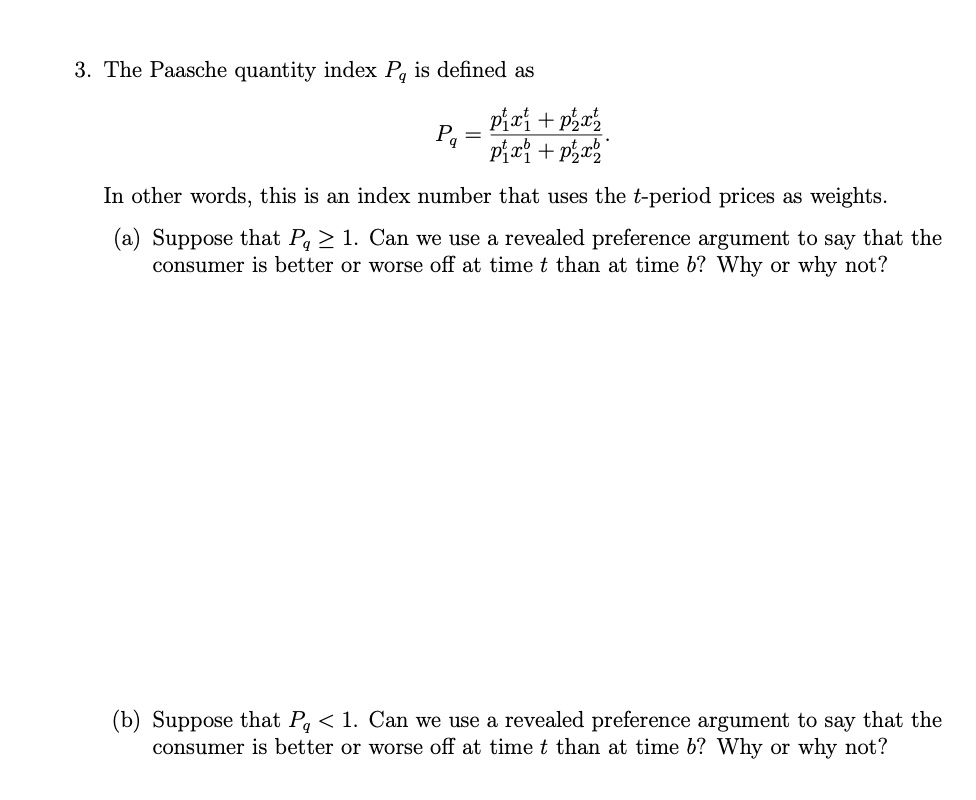
3. The Paasche quantity index $P_q$ is defined as
$$P_q = \frac{p_1^t x_1^t + p_2^t x_2^t}{p_1^t x_1^b + p_2^t x_2^b}.$$
In other words, this is an index number that uses the $t$-period prices as weights.
(a) Suppose that $P_q \ge 1$. Can we use a revealed preference argument to say that the consumer is better or worse off at time $t$ than at time $b$? Why or why not?
(b) Suppose that $P_q < 1$. Can we use a revealed preference argument to say that the consumer is better or worse off at time $t$ than at time $b$? Why or why not?