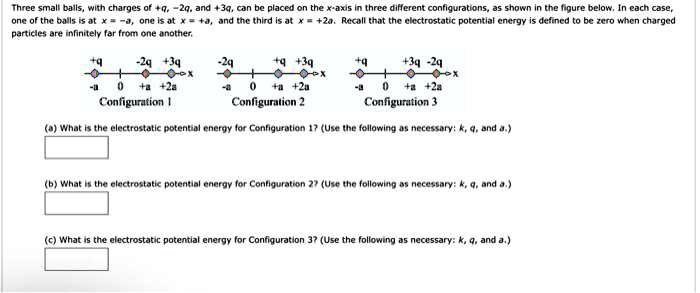
Three small balls, with charges of +q, -2q, and +3q, can be placed on the x-axis in three different configurations, as shown in the figure below. In each case,
one of the balls is at $x = -a$, one is at $x = +a$, and the third is at $x = +2a$. Recall that the electrostatic potential energy is defined to be zero when charged
particles are infinitely far from one another.
+q -2q +3q
-a 0 +a +2a
Configuration 1
-2q +q +3q
-a 0 +a +2a
Configuration 2
+q +3q -2q
-a 0 +a +2a
Configuration 3
(a) What is the electrostatic potential energy for Configuration 1? (Use the following as necessary: k, q, and a.)
(b) What is the electrostatic potential energy for Configuration 2? (Use the following as necessary: k, q, and a.)
(c) What is the electrostatic potential energy for Configuration 3? (Use the following as necessary: k, q, and a.)