Ace - AI Tutor
Ask Our Educators
Textbooks
My Library
Flashcards
Scribe - AI Notes
Notes & Exams
Download App
alberto clements

alberto c.

Divider

Questions asked

BEST MATCH

Gases move from where they exert a \_\_\_\_\_\_ partial pressure to where they have a \_\_\_\_\_\_ partial pressure. high, low low, high

View Answer
divider
BEST MATCH

a) Using the Michaelis--Menten Equation, what is the V0/Vmax reaction when[S] is 4 x Km?

View Answer
divider
BEST MATCH

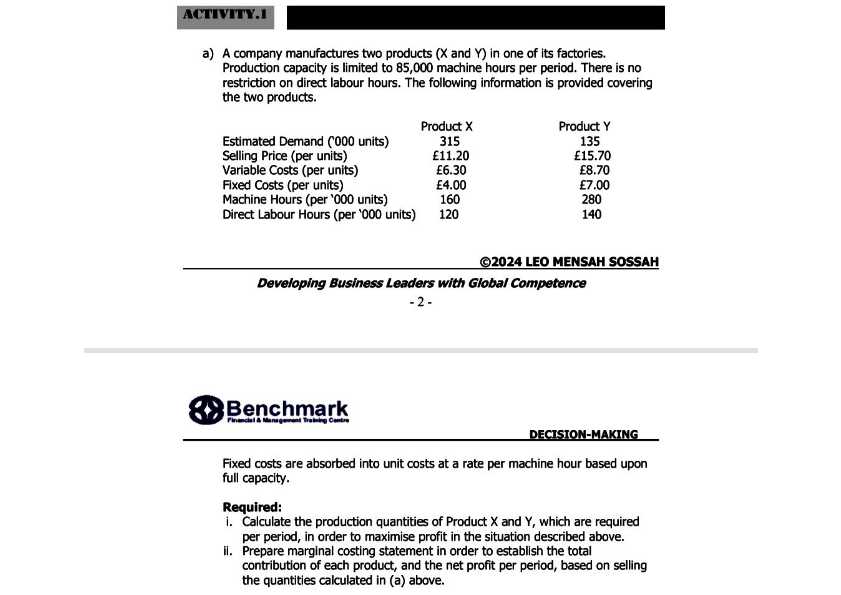
ACTIVITY. 1 a) A company manufactures two products ( \( X \) and \( Y \) ) in one of its factories. Production capacity is limited to 85,000 machine hours per period. There is no restriction on direct labour hours. The following information is provided covering the two products. \begin{tabular}{lcc} & Product \( X \) & Product Y \\ & 315 & 135 \\ Estimated Demand (co00 units) & \( £ 11.20 \) & \( £ 15.70 \) \\ Selling Price (per units) & \( £ 6.30 \) & \( £ 8.70 \) \\ Variable Costs (per units) & \( £ 4.00 \) & \( £ 7.00 \) \\ Fixed Costs (per units) & 160 & 280 \\ Machine Hours (per '000 units) & 120 & 140 \\ Direct Labour Hours (per '000 units) & 120 & \end{tabular} (c)2024 LEO MENSAH SOSSAH Developing Business Leaders with Global Competence -2 - Benchmark DECISION-MAKING Fixed costs are absorbed into unit costs at a rate per machine hour based upon full capacity. Required: 1. Calculate the production quantities of Product \( X \) and \( Y \), which are required per period, in order to maximise profit in the situation described above. ii. Prepare marginal costing statement in order to establish the total contribution of each product, and the net profit per period, based on selling the quantities calculated in (a) above.
View Answer
divider
BEST MATCH

The monetary base is equal to: currency held by the public plus bank reserves. currency held by the public plus bank deposits. M1. total bank deposits. The monetary base is equal to: O currency held by the public plus bank reserves O currency held by the public plus bank deposits OM1. total bank deposits

View Answer
divider
BEST MATCH

Exercise II. Find the general solution to (15) 1. $\frac{1}{x}y' - \frac{2}{x^2}y = -x\cos x$ (15) 2. $y' + y = \frac{1}{1 + e^{2x}}$

View Answer
divider
BEST MATCH

QUESTION 1 What is $E^\circ_{cell}$ for the following reaction? Al(s) + 3Ag$^+$ (aq) $\rightarrow$ Al$^{3+}$(aq) + 3Ag(s) Al$^{3+}$(aq) + 3e$^-$ $\rightarrow$ Al(s) $E^\circ$ = -1.66 V Ag$^+$ (aq) + e$^-$ $\rightarrow$ Ag(s) $E^\circ$ = 0.80 V O 4.06 V O 2.46 V O -2.46 V O -0.86 V O 0.86 V

View Answer
divider
BEST MATCH

In Exercises 1-26, determine whether the given series converges or\ndiverges by using any appropriate test. The $p$-series can be used\nfor comparison, as can geometric series. Be alert for series whose\nterms do not approach 0.\n$\sum_{n=1}^{8} \frac{1}{n^2 + 1}$\n$\sum_{n=1}^{8} \frac{n}{n^4 - 2}$\n$\sum_{n=1}^{8} \frac{n^2 + 1}{n^3 + 1}$\n$\sum_{n=1}^{8} \frac{\sqrt{n}}{n^2 + n + 1}$\n$\sum_{n=1}^{8} |sin\frac{1}{n^2}|$\n$\sum_{n=8}^{8} \frac{1}{\pi n + 5}$\n$\sum_{n=2}^{8} \frac{1}{(ln n)^3}$\n$\sum_{n=1}^{8} \frac{1}{\pi n - n \pi}$\n$\sum_{n=0}^{8} \frac{1 + n}{2 + n}$

View Answer
divider
BEST MATCH

Macmillan Learning Suppose you spray your sister with water from a garden hose. The water is supplied to the hose at a rate of 0.445 \times 10^{-3} m^3/s and the diameter of the nozzle you hold is 5.85 \times 10^{-3} m. At what speed $v$ does the water exit the nozzle? m/s

View Answer
divider
BEST MATCH

5) Now repeat this for a diffraction function that repeats over distance "a" (good for Fourier Series) $f(x) = 1 + Cos(\frac{2\pi}{a}x)$ $f(x + na) = f(x)$ $f(x) = \sum_{n = -\infty}^{\infty} g_n e^{ik_n x}$ Again a = 0.001mm. Try to solve this with algebra (by changing the expression for Cos(z) to forms involving $e^{\pm iz}$) without doing any integrals! a. Determine $k_n = nk_0$ and $g_n$ as a function of n. (how many non-zero terms are there?). b. Determine the angles relative to the z axis associated with diffraction peaks for each of the nonzero terms (n=?). c. Determine the relative intensities of these diffraction peaks, using the square of amplitude $|g_n|^2$ for n = -1,0,1,2,3 for each of "N" terms for which $g_n$ is non-zero. So $f(x) = \sum_{n=-N}^{N} g_n e^{ik_n x}$

View Answer
divider
BEST MATCH

Find the Inverse Laplace of $F(s) = \frac{s^2 + s + 4}{(s+3)(s^2 - 4)}$ A $2e^{-3t} + 2\cosh{2t} + \sinh{2t}$ B $2e^{-3t} - \cosh{2t} - 2\sinh{2t}$ C $2e^{-3t} - \cosh{2t} + 2\sinh{2t}$ D $2e^{-3t} - 2\cosh{2t} + \sinh{2t}$ E $2e^{-3t} + \cosh{2t} + \sinh{2t}$

View Answer
divider