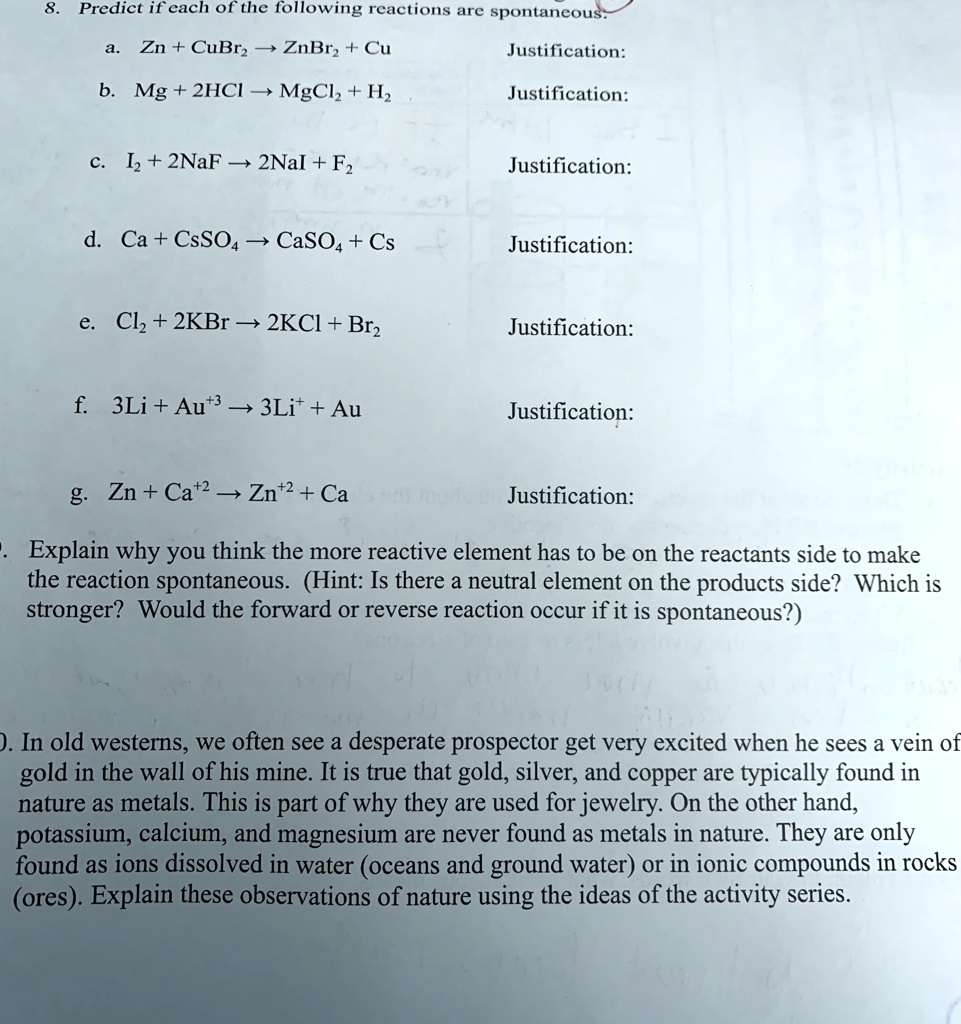
8. Predict if each of the following reactions are spontaneous.
a. Zn + CuBr?? ZnBr? + Cu Justification:
b. Mg + 2HCl ? MgCl? + H? Justification:
c. I? + 2NaF ? 2NaI + F? Justification:
d. Ca + CsSO? ? CaSO? + Cs Justification:
e. Cl? + 2KBr ? 2KCl + Br? Justification:
f. 3Li + Au?³ ? 3Li? + Au Justification:
g. Zn + Ca?² ? Zn?² + Ca Justification:
. Explain why you think the more reactive element has to be on the reactants side to make
the reaction spontaneous. (Hint: Is there a neutral element on the products side? Which is
stronger? Would the forward or reverse reaction occur if it is spontaneous?)
D. In old westerns, we often see a desperate prospector get very excited when he sees a vein of
gold in the wall of his mine. It is true that gold, silver, and copper are typically found in
nature as metals. This is part of why they are used for jewelry. On the other hand,
potassium, calcium, and magnesium are never found as metals in nature. They are only
found as ions dissolved in water (oceans and ground water) or in ionic compounds in rocks
(ores). Explain these observations of nature using the ideas of the activity series.