Problem #1
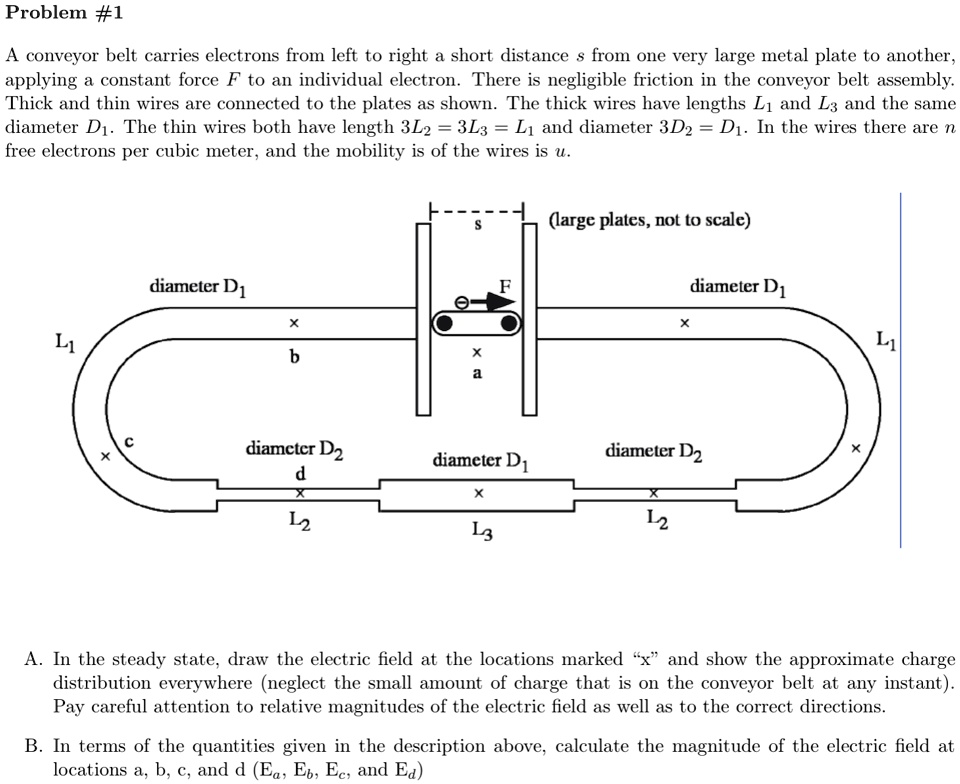
A conveyor belt carries electrons from left to right a short distance s from one very large metal plate to another, applying a constant force F to an individual electron. There is negligible friction in the conveyor belt assembly. Thick and thin wires are connected to the plates as shown. The thick wires have lengths L1 and L3 and the same diameter D1. The thin wires both have length 3L2 = 3L3 = L1 and diameter 3D2 = D1. In the wires there are n free electrons per cubic meter, and the mobility is of the wires is u.
diameter D1, L1, b, x, s, (large plates, not to scale), diameter D1, L1, x, a, F, x, c, diameter D2, d, L2, diameter D1, L3, x, diameter D2, L2, x
A. In the steady state, draw the electric field at the locations marked "x" and show the approximate charge distribution everywhere (neglect the small amount of charge that is on the conveyor belt at any instant). Pay careful attention to relative magnitudes of the electric field as well as to the correct directions.
B. In terms of the quantities given in the description above, calculate the magnitude of the electric field at locations a, b, c, and d (Ea, Eb, Ec, and Ed)