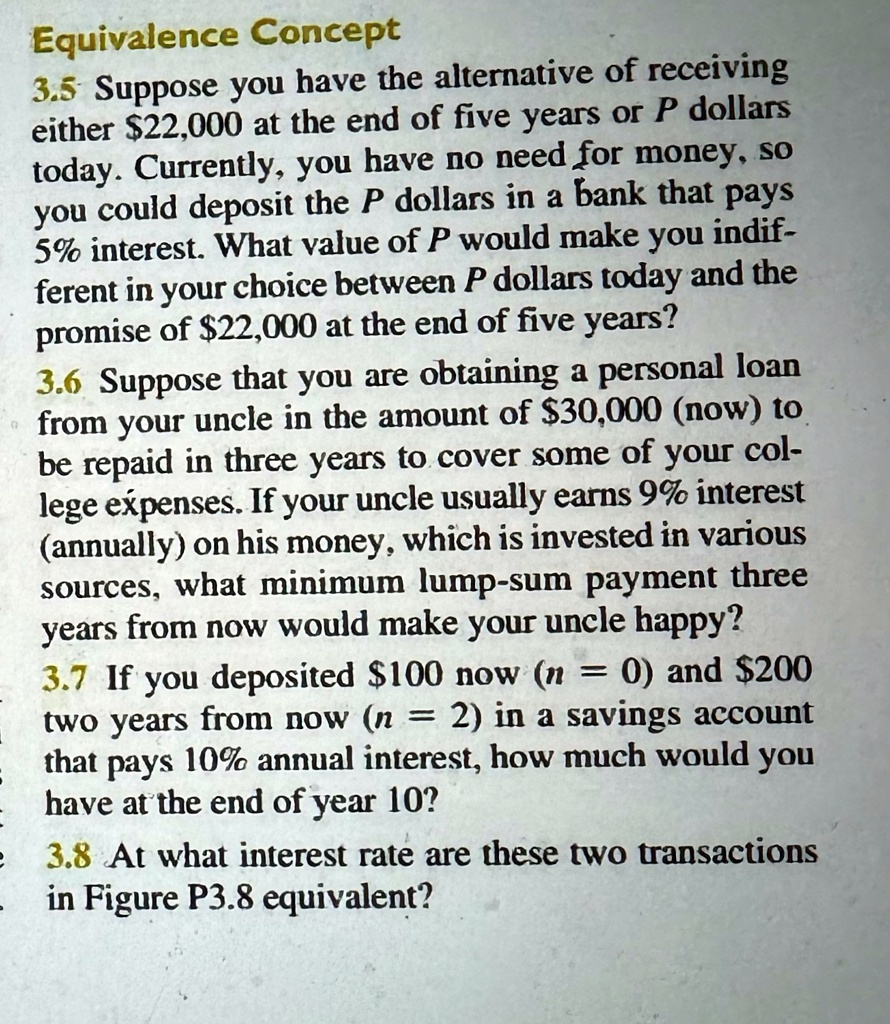
Equivalence Concept
3.5 Suppose you have the alternative of receiving either $22,000 at the end of five years or P dollars today. Currently, you have no need for money, so you could deposit the P dollars in a bank that pays 5% interest. What value of P would make you indifferent in your choice between P dollars today and the promise of $22,000 at the end of five years?
3.6 Suppose that you are obtaining a personal loan from your uncle in the amount of $30,000 (now) to be repaid in three years to cover some of your college expenses. If your uncle usually earns 9% interest (annually) on his money, which is invested in various sources, what minimum lump-sum payment three years from now would make your uncle happy?
3.7 If you deposited $100 now (n)=(0) and $200 two years from now (n)=(2) in a savings account that pays 10% annual interest, how much would you have at the end of year 10 ?
3.8 At what interest rate are these two transactions in Figure P3.8 equivalent?
Eguivalence Concept 3.5 Suppose you have the alternative of receiving either $22.000 at the end of five years or P dollars today. Currently, you have no need for money, so you could deposit the P dollars in a bank that pays 5% interest. What value of P would make you indif- ferent in your choice between P dollars today and the promise of $22,000 at the end of five years? 3.6 Suppose that you are obtaining a personal loan from your uncle in the amount of $30,000 (now) to be repaid in three years to.cover some of your col- lege expenses. If your uncle usually earns 9% interest (annually) on his money, which is invested in various sources, what minimum lump-sum payment three years from now would make your uncle happy? 3.7 If you deposited $100 now (n = 0) and $200 two years from now (n = 2) in a savings account that pays 10% annual interest, how much would you have at'the end of year 10? 3.8 At what interest rate are these two transactions in Figure P3.8 equivalent?