PART E
College Pro Painting
You have decided that for your summer job you are going to manage a group of students who will
paint houses to earn money for the summer. As Manager, your paycheck depends on your
capability to efficiently schedule the team so that all the houses get painted on time with little, or
ideally no, overage on scheduled man-hours.
Given that a house requires H man-hours to paint, your team has N houses to paint and S students
on the team:
i. Write the expression that relates the number of students that you will need to schedule to finish
painting the houses in 12 weeks assuming 40-hour work weeks.
ii. If it takes 160 man-hours to paint a house and your team has 39 houses to paint, how many
students do you need to hire to paint the houses in 12 weeks assuming 40-hour workweeks?
iii. A friend of yours, Bionka, managed a College Pro Painting team last summer and tells you
that since every student is not as efficient as you may expect combined with the fact that the
neighborhood you're covering has both small and large houses, the number of man-hours to paint
a house, H, is not exactly 160. Instead, she tells you that H is equally likely to take anywhere from
150 man-hours to 180 man-hours. Additionally, Bionka hints that not all of your workers show
up as expected. In fact, during a given week a man-day (8 hours) of work is lost on the average of
1.6 times. Fill in the following probability tables:
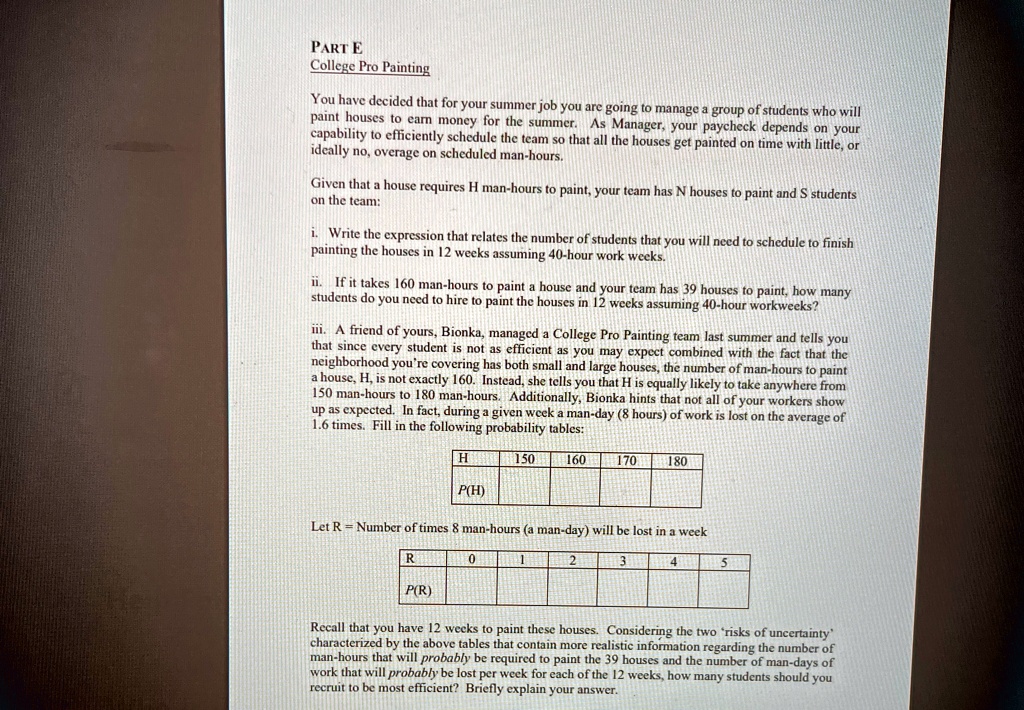
H
150 160 170 180
P(H)
Let R = Number of times 8 man-hours (a man-day) will be lost in a week
R
0
1
2
3
4
5
P(R)
Recall that you have 12 weeks to paint these houses. Considering the two 'risks of uncertainty
characterized by the above tables that contain more realistic information regarding the number of
man-hours that will probably be required to paint the 39 houses and the number of man-days of
work that will probably be lost per week for each of the 12 weeks, how many students should you
recruit to be most efficient? Briefly explain your answer.