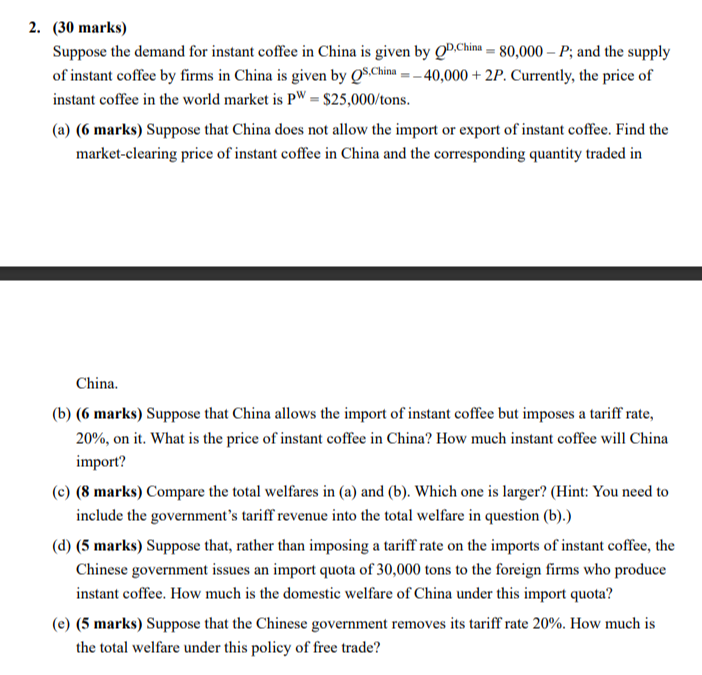
2. (30 marks)
Suppose the demand for instant coffee in China is given by \( Q^{\mathrm{D}, \text { China }}=80,000-P \); and the supply of instant coffee by firms in China is given by \( Q^{\text {S, China }}=-40,000+2 P \). Currently, the price of instant coffee in the world market is \( \mathrm{P}^{\mathrm{W}}=\$ 25,000 / \) tons.
(a) (6 marks) Suppose that China does not allow the import or export of instant coffee. Find the market-clearing price of instant coffee in China and the corresponding quantity traded in
China.
(b) ( 6 marks) Suppose that China allows the import of instant coffee but imposes a tariff rate, \( 20 \% \), on it. What is the price of instant coffee in China? How much instant coffee will China import?
(c) (8 marks) Compare the total welfares in (a) and (b). Which one is larger? (Hint: You need to include the government's tariff revenue into the total welfare in question (b).)
(d) (5 marks) Suppose that, rather than imposing a tariff rate on the imports of instant coffee, the Chinese government issues an import quota of 30,000 tons to the foreign firms who produce instant coffee. How much is the domestic welfare of China under this import quota?
(e) (5 marks) Suppose that the Chinese government removes its tariff rate \( 20 \% \). How much is the total welfare under this policy of free trade?