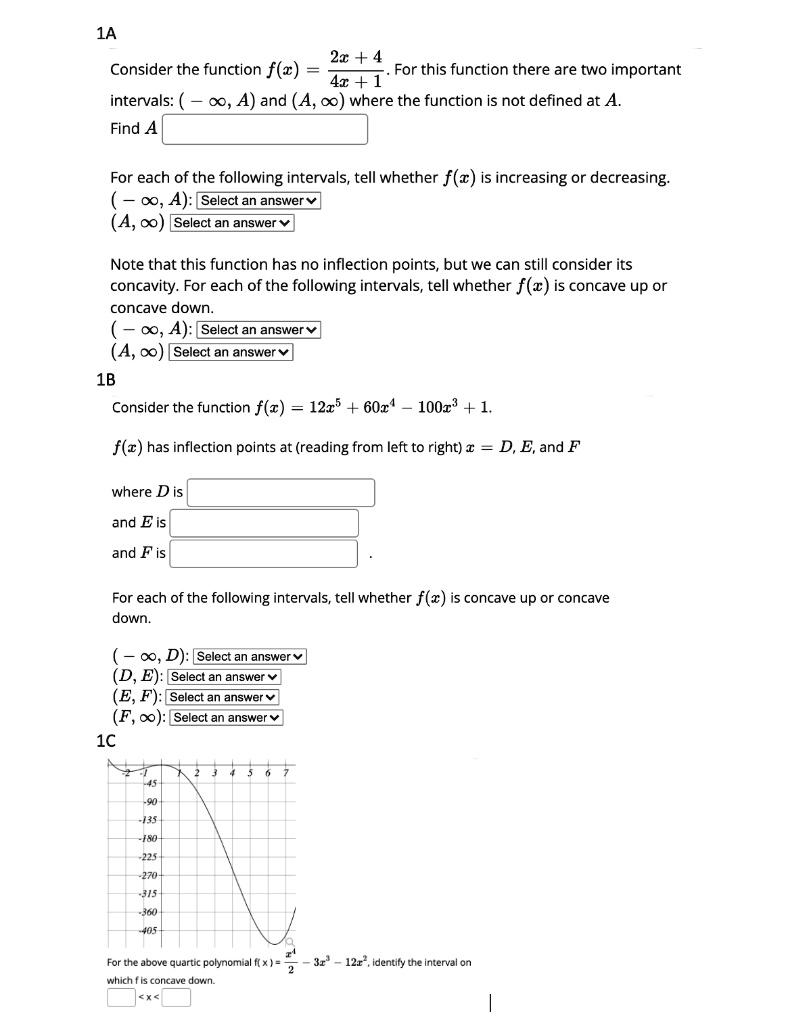
2+4 Consider the function f(x) = √(4x+1). For this function, there are two important intervals: (-∞, A) and (A, ∞) where the function is not defined at A. Find A.
For each of the following intervals, tell whether f(x) is increasing or decreasing. (-∞, A): [Select an answer] (A, ∞): [Select an answer]
Note that this function has no inflection points, but we can still consider its concavity. For each of the following intervals, tell whether f(x) is concave up or concave down. (-∞, A): [Select an answer] (A, ∞): [Select an answer]
Consider the function f(x) = 12x^5 + 604x - 1003 + 1. f(x) has inflection points at (reading from left to right): D, E, and F, where D is [Select an answer], E is [Select an answer], and F is [Select an answer].
For each of the following intervals, tell whether f(x) is concave up or concave down. -D: [Select an answer] (D, E): [Select an answer] (E, F): [Select an answer] (F, ∞): [Select an answer]
For the interval (45, 270), identify the interval on which f(x) is concave down.