Problem 3 (35 points)
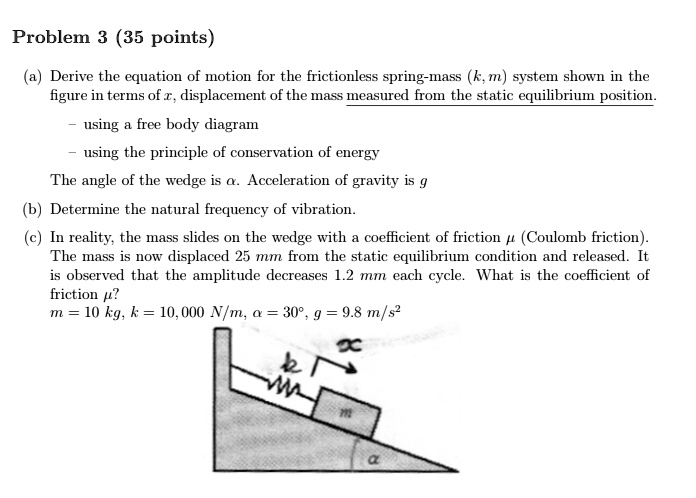
(a) Derive the equation of motion for the frictionless spring-mass ($k$, $m$) system shown in the
figure in terms of $x$, displacement of the mass measured from the static equilibrium position.
\text{ -- using a free body diagram}
\text{ -- using the principle of conservation of energy}
The angle of the wedge is $\alpha$. Acceleration of gravity is $g$
(b) Determine the natural frequency of vibration.
(c) In reality, the mass slides on the wedge with a coefficient of friction $\mu$ (Coulomb friction).
The mass is now displaced 25 $mm$ from the static equilibrium condition and released. It
is observed that the amplitude decreases 1.2 $mm$ each cycle. What is the coefficient of
friction $\mu$?
$m = 10\text{ kg}$, $k = 10,000\text{ N/m}$, $\alpha = 30^\circ$, $g = 9.8\text{ m/s}^2$