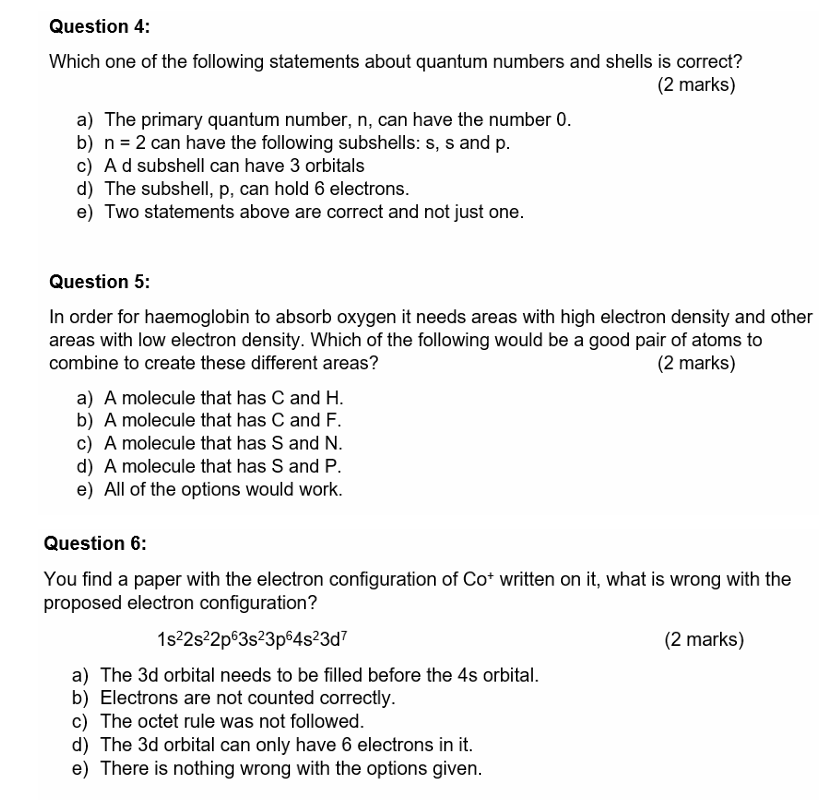
Question 4:
Which one of the following statements about quantum numbers and shells is correct?
(2 marks)
a) The primary quantum number, n , can have the number 0 .
b) \( n=2 \) can have the following subshells: \( s, s \) and \( p \).
c) A d subshell can have 3 orbitals
d) The subshell, p, can hold 6 electrons.
e) Two statements above are correct and not just one.
Question 5:
In order for haemoglobin to absorb oxygen it needs areas with high electron density and other areas with low electron density. Which of the following would be a good pair of atoms to combine to create these different areas?
(2 marks)
a) A molecule that has C and H .
b) A molecule that has \( C \) and \( F \).
c) A molecule that has \( S \) and \( N \).
d) A molecule that has \( S \) and \( P \).
e) All of the options would work.
Question 6:
You find a paper with the electron configuration of \( \mathrm{Co}^{+} \)written on it, what is wrong with the proposed electron configuration?
\[
1 s^{2} 2 s^{2} 2 p^{6} 3 s^{2} 3 p^{6} 4 s^{2} 3 d^{7}
\]
(2 marks)
a) The 3 d orbital needs to be filled before the 4 s orbital.
b) Electrons are not counted correctly.
c) The octet rule was not followed.
d) The 3d orbital can only have 6 electrons in it.
e) There is nothing wrong with the options given.