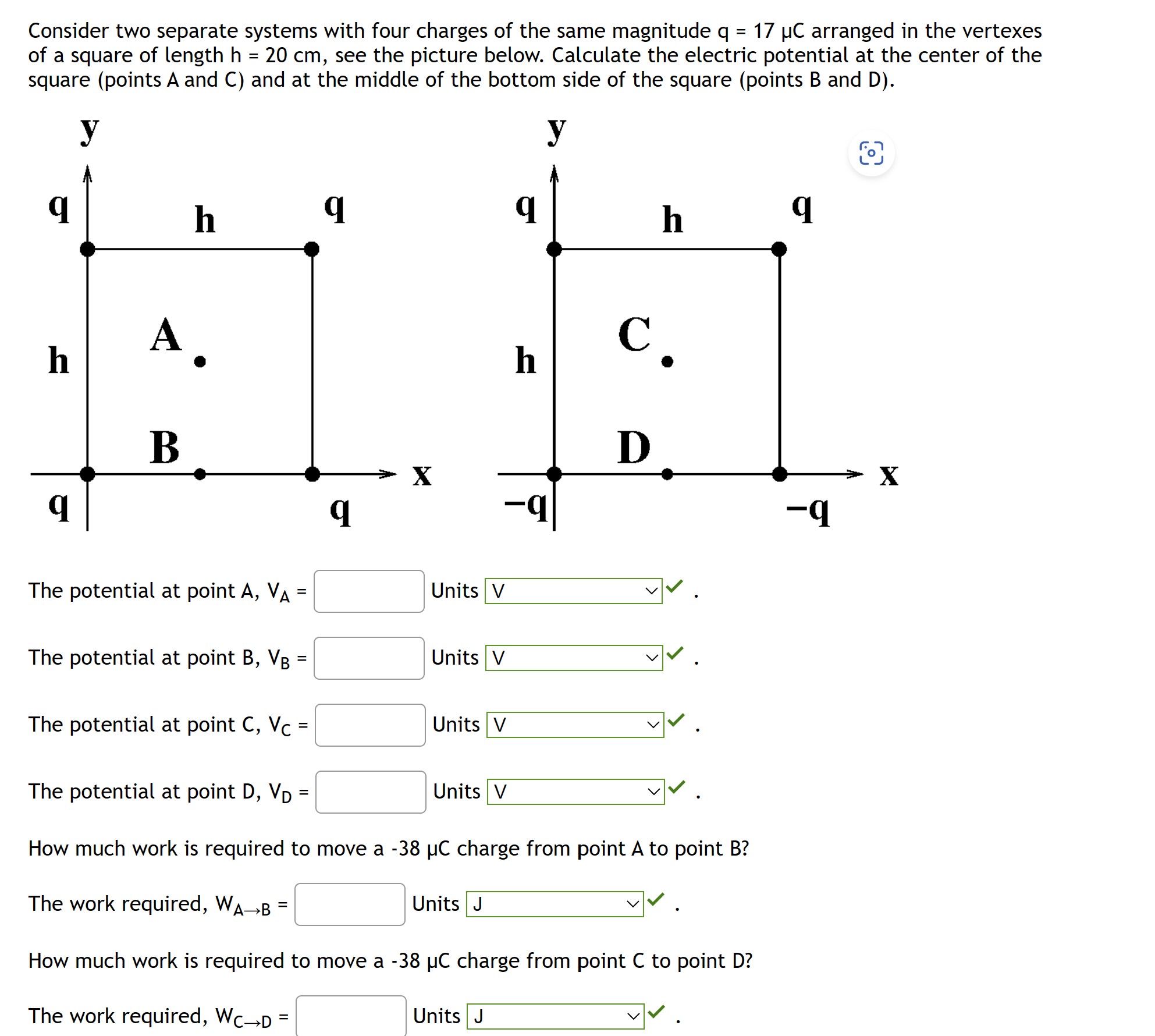
Consider two separate systems with four charges of the same magnitude \( \mathrm{q}=17 \mu \mathrm{C} \) arranged in the vertexes of a square of length \( h=20 \mathrm{~cm} \), see the picture below. Calculate the electric potential at the center of the square (points \( A \) and \( C \) ) and at the middle of the bottom side of the square (points \( B \) and \( D \) ).
\( \mathbf{h} \underset{-\mathbf{q}}{\mathbf{C}} \underset{\mathbf{D}}{\mathbf{C}} \underset{\mathbf{q}}{\mathbf{q}} \mathbf{q} \mathbf{x} \)
The potential at point \( \mathrm{A}, \mathrm{V}_{\mathrm{A}}= \) Units \( V \)
The potential at point \( B, V_{B}= \) Units \( \vee \)
The potential at point \( \mathrm{C}, \mathrm{V}_{\mathrm{C}}= \) Units \( \vee \)
The potential at point \( D, V_{D}= \) Units \( V \quad \vee \checkmark \).
How much work is required to move a \( -38 \mu \mathrm{C} \) charge from point \( A \) to point \( B \) ?
The work required, \( \mathrm{W}_{\mathrm{A} \rightarrow B}= \) Units \( J \quad \vee \checkmark \).
How much work is required to move a \( -38 \mu \mathrm{C} \) charge from point \( \mathrm{C} \) to point \( \mathrm{D} \) ?
The work required, \( \mathrm{W}_{\mathrm{C} \rightarrow \mathrm{D}}= \)