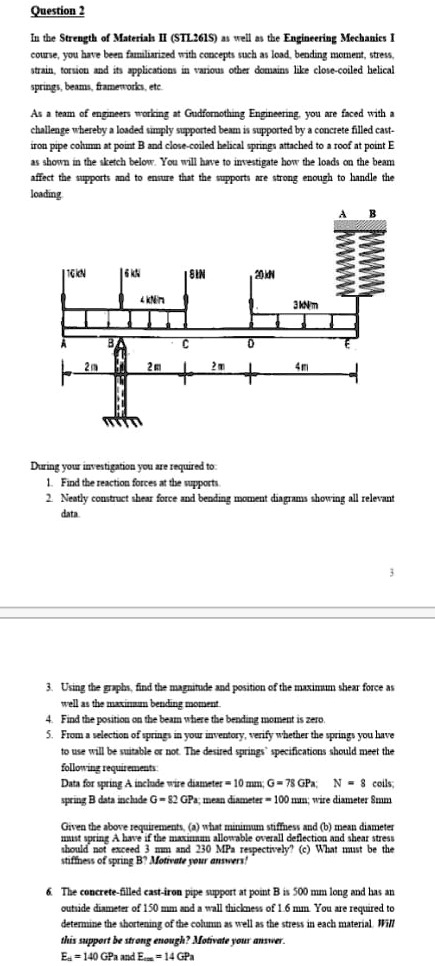
In the Strength of Materials II (STL261S) as well as the Engineering Mechanics I course, you have been familiarized with concepts such as load, bending moment, stress, strain, torsion, and their application in various other domains like close-coiled helical springs, beams, frameworks, etc.
Now, you are faced with a challenge whereby a loaded simply supported beam is supported by a concrete-filled cast-iron pipe column at point B and close-coiled helical springs attached to a roof at point E as shown in the sketch below. You will have to investigate how the loads on the beam affect the reactions at the supports.
During your investigation, you are required to:
1. Find the reaction forces at the supports.
2. Neatly construct shear force and bending moment diagrams showing all relevant data.
3. Using the graphs, find the magnitude and position of the maximum shear force as well as the maximum bending moment.
4. Find the position on the beam where the bending moment is zero.
5. From a selection of springs in your inventory, verify whether the springs you have to use will be suitable or not. The desired springs' specifications should meet the following requirements:
- Data for spring A includes wire diameter = 10mm, G = 78 GPa, N = 8 coils.
- Data for spring B includes G = 2 GPa, mean diameter = 100 mm, wire diameter = 5 mm.
Given the above requirements, answer the following questions:
(a) What minimum stiffness and (b) mean diameter must spring A have if the maximum allowable overall deflection and shear stress are to be within certain limits? Derive your answers.
The concrete-filled cast-iron pipe support at point B is 500 mm long and has an outside diameter of 150 mm and a wall thickness of 1.6 mm. You are required to determine the shortening of the column as well as the stress in each material. Will this support be strong enough? Motivate your answer. E = 140 GPa and E = 14 GPa.