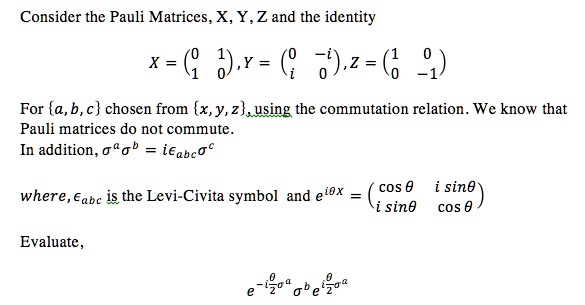
Consider the Pauli Matrices, X, Y, Z and the identity
$X = \begin{pmatrix} 0 & 1 \\ 1 & 0 \end{pmatrix}$, $Y = \begin{pmatrix} 0 & -i \\ i & 0 \end{pmatrix}$, $Z = \begin{pmatrix} 1 & 0 \\ 0 & -1 \end{pmatrix}$
For \{a, b, c\} chosen from \{x, y, z\}, using the commutation relation. We know that
Pauli matrices do not commute.
In addition, $\sigma^a \sigma^b = i\epsilon_{abc}\sigma^c$
where, $\epsilon_{abc}$ is the Levi-Civita symbol and $e^{i\theta X} = \begin{pmatrix} cos\theta & i sin\theta \\ i sin\theta & cos\theta \end{pmatrix}$
Evaluate,
$e^{-i\frac{\theta}{2}\sigma^a}\sigma^b e^{i\frac{\theta}{2}\sigma^a}$