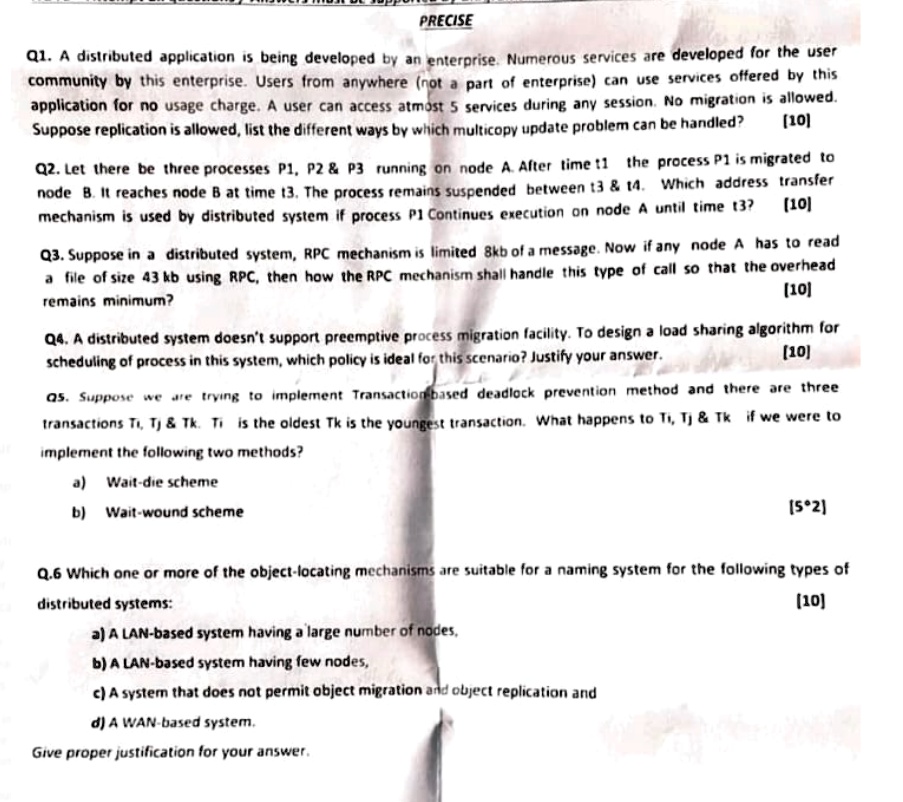
Q1. A distributed application is being developed by an enterprise. Numerous services are developed for the user community by this enterprise. Users from anywhere (not a part of enterprise) can use services offered by this application for no usage charge. A user can access atmost 5 services during any session. No migration is allowed. Suppose replication is allowed, list the different ways by which multicopy update problem can be handled? [10]
Q2. Let there be three processes P1, P2 & P3 running on node A. After time 11 the process P1 is migrated to node B. It reaches node B at time 13. The process remains suspended between 13 & 14. Which address transfer mechanism is used by distributed system if process P1 Continues execution on node A until time 13? [10]
Q3. Suppose in a distributed system, RPC mechanism is limited 8kb of a message. Now if any node A has to read a file of size 43 kb using RPC, then how the RPC mechanism shall handle this type of call so that the overhead remains minimum? [10]
Q4. A distributed system doesn't support preemptive process migration facility. To design a load sharing algorithm for scheduling of process in this system, which policy is ideal for this scenario? Justify your answer. [10]
Q5. Suppose we are trying to implement Transaction based deadlock prevention method and there are three transactions Ti, Tj & Tk. Ti is the oldest Tk is the youngest transaction. What happens to Ti, Tj & Tk if we were to implement the following two methods? a) Wait-die scheme b) Wait-wound scheme [5*2]
Q.6 Which one or more of the object-locating mechanisms are suitable for a naming system for the following types of distributed systems: a) A LAN-based system having a large number of nodes, b) A LAN-based system having few nodes, c) A system that does not permit object migration and object replication and d) A WAN-based system. Give proper justification for your answer. [10]