Questions asked
Astronomers measure that Planet A moves around its star in a circular orbit with radius R = 2 million km and with a period of T = 3 years. A second planet in the same system (Planet B) moves around that same star with a period of TB = 12 years. What is its orbital radius?
Using R6 as a temporary storage for your code, write the assembly instruction(s) to perform the following operations on the ARM Cortex MO+: a. Add OxEA to register R1, placing the sum in register RO. b. Subtract OxDEADBEEF from register R2, placing the result in register R2. c. Add the value OxE1EC0334 to register R4, placing the sum in register R3. d. Place -334 into register R4 using the two's complement representation
1. Consider the block diagram of a dynamic system as shown in the figure below: Input + K G(s) Output A dynamic system in Unity Negative Feedback Form (s+0.995) If $G(s) = \frac{(s+0.995)}{s(s+2)(s^2+4s+3)(s+8)}$ i. (1 points) Determine the type of the system. ii. (2 points) Using the Routh table, determine the range of the values of the gain K so that the closed loop system is stable. iii. (2 points) Using the information in the Routh table, determine the value of the gain K such that there are two poles on the $j\omega$ axis.
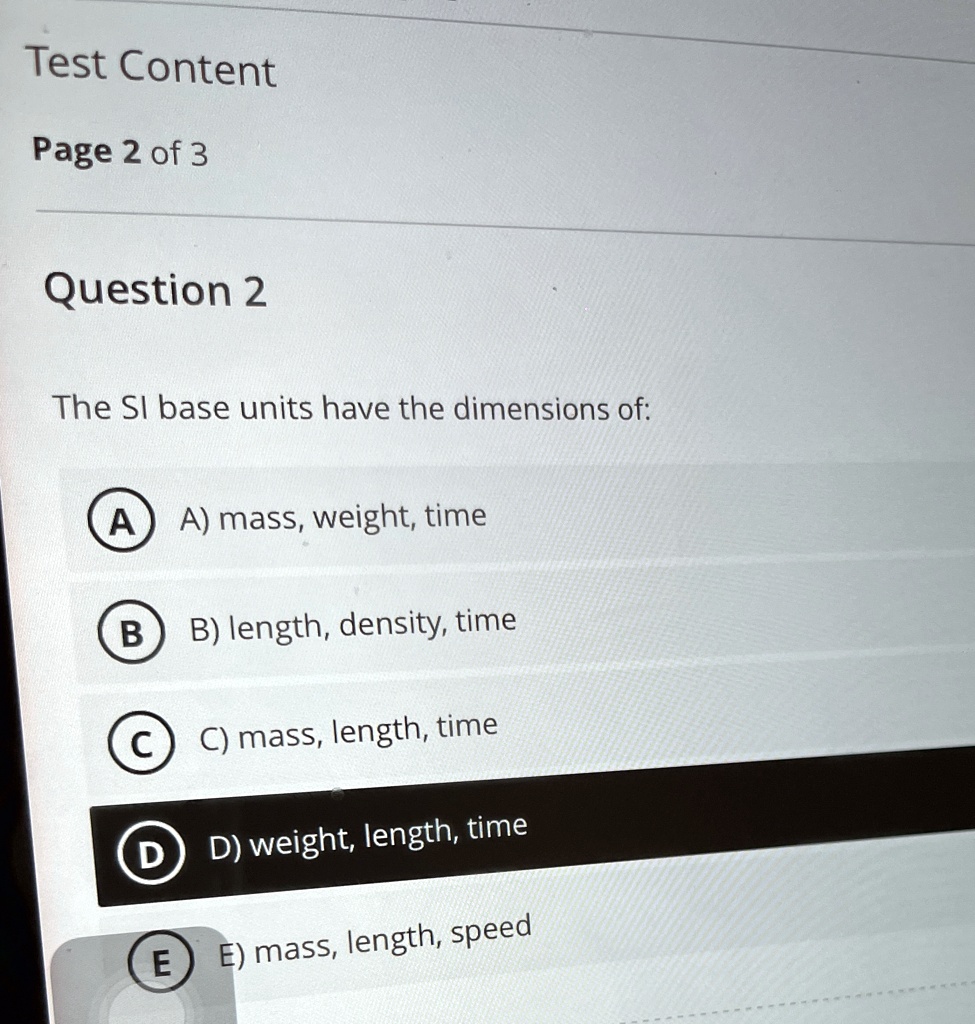
Test Content Page 2 of 3 Question 2 The SI base units have the dimensions of: A) mass, weight, time B) length, density, time C) mass, length, time D) weight, length, time E) mass, length, speed
If you were asked to explain Freud's structure of the mind to a friend who was unfamiliar with psychology, you might use an organizational analogy in which the id would be the employee who comes to work late and takes very long lunch hours, the superego would be the building security guard, and the ego would be a recently fired employee. a newly hired employee. a manager. a salesperson.
What is an important concept of construct validity? The measure used in the study sometimes measures the conceptual variables The manipulation in an experiment really manipulates the conceptual variable The manipulation in an experiment manipulates the experimenter The measure used in the study rarely measures the conceptual variables
2. A 70 cm$^3$ loop of wire (shown here in side view) with 150 turns and with a current $I = 2A$ running through it is placed between the poles of a magnet with $B = 1T$. Note that the loop is fixed through its center (the gray dot) and so, although it is free to rotate, it cannot move from side to side. B N S 1 2 a) Assuming that the loop is initially placed between the poles in the orientation shown, use the right hand rule or energy arguments to determine which side, 1 or 2, ends up facing the north pole once the loop has reached equilibrium. [3 pts] b) If the angle $\theta$ between the plane of the loop and the magnetic field is 30$^\circ$ at the instant shown, what is the torque $\tau$ on the loop? [5 pts] c) What are the direction and magnitude (numerical value) of the current induced in the loop as it starts to rotate? Explain your reasoning. [2 pts]
Question 8 For a glass (n = 1.52) / quartz (n = 1.38) interface and an angle of incidence of 35°, determine: a. the angle of refraction. b. critical angle. c. acceptance angle. d. numerical aperture.
Find the area of the region bounded by the graphs of the function $f(x) = \frac{13x}{x^2 + 5}$, $y = 0$, $0 \le x \le 5$. Round your answer to three decimal places. 11.646 42.355 21.659 21.178
Question 38 1pts Services a statistician may provide include all EXCEPT - Recommend sample size - Perform experiments - Plan data analysis - Prepare tables, figures, graphs, etc. Question 39 1pts The following is a common statistical test/technique: - Student's t-test - Chi-square test - Analysis of Variance (ANOVA) - All of the above